What is it about eagle eyes that makes them the best of all animals? (4 photos + 1 video)
When it comes to vision, eagles are considered to be at the pinnacle of visual evolution. And this reputation is well deserved - they can spot their prey at such a distance that we would need binoculars, which means that their visual acuity is far superior to ours. So what is it about eagle eyes that makes them the best of all animals? 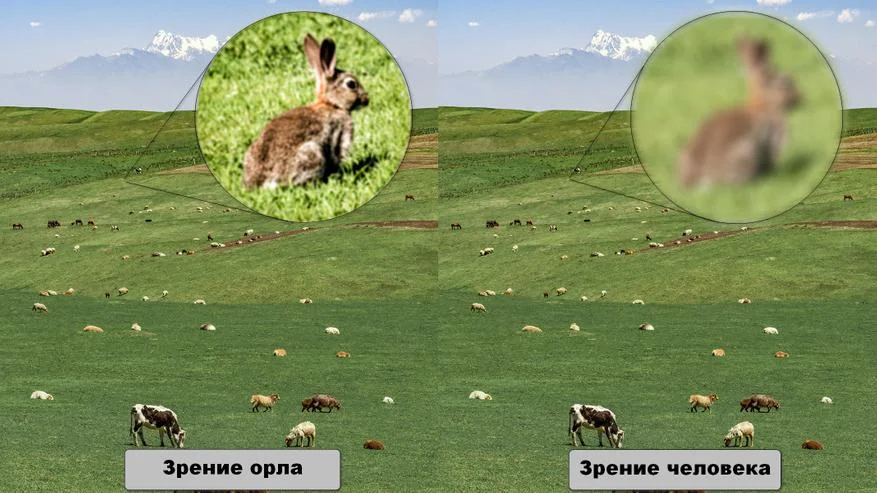
Cones, one of the reasons for sharp vision
Eagles have keen eyesight and can easily spot prey on the ground from great heights. If humans had vision as good as an eagle, we could see an ant on the ground while standing on the roof of a 9-story building or notice another eagle soaring 30 km away. The secret to exceptional vision lies in the density of photoreceptor cells on the retina, the unique structure of the eye, and a well-developed muscular system that allows them to focus quickly and accurately on objects.
The eyes of any animal have photoreceptor cells - cones and rods. Cones are color sensitive and provide color vision. The rods, in turn, provide black and white vision and are responsible for vision in low light. Humans have 180,000 cells per square millimeter of retina, while eagles have about a million cells per square millimeter of retina. Moreover, if a person has 5% of cones, then an eagle has 80% of them, that is, in addition to high resolution, the predator also has much higher sensitivity to color, which allows them to distinguish details and colors at long distances.
This is especially impressive considering that eagles have two fossae: a deep fossa and a shallow fossa. The fovea is a depression in the retina of the eye that contains a large number of concentrically located photoreceptor cells and the more of them, the more clearly objects are visible in the center of the visual field. Humans only have one pit, so eagles have a significant advantage in this regard. So a deep fossa has a strong concavity and a high density of cells, and together with the vitreous body located in the fossa, the eagle receives a telephoto eye, allowing it to see 4-5 times further than a person.
The shallow fovea is used by the bird for stereoscopic binocular vision to look at close objects within a radius of 40 meters. The reason why the second fossa appeared is that the eagle's eye is elongated, so it hardly rotates in the socket and the eagle must turn its head to change the perspective. However, if you look with one eye, the ability to perceive depth and distance disappears, so this is how evolution corrected this shortcoming. 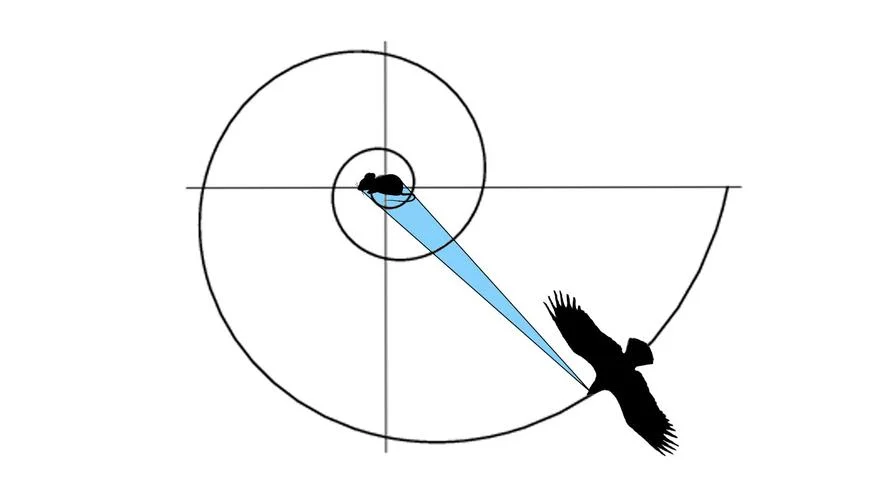
This is how an eagle watches its prey, descending towards it in a logarithmic spiral.
This structural feature of the eye plays a big role in the hunting of eagles. Anatomically deep fossa has higher visual acuity. Therefore, at the beginning of the hunting process, when the eagle has noticed but is far from the prey, it descends in a logarithmic spiral, observing it with the help of more advanced peripheral vision. And when there are approximately 30-50 meters left before the prey, it switches to a straight-line movement and switches its vision to the second small dimple.
Eagles can see amazing colors
Eagles have significantly greater color sensitivity than humans. They are able to distinguish many shades that look monochromatic to us. According to research, a bird's eye sees about 10 times more shades on a sunny day than is available to humans in the same spectrum. But the main feature of their vision is that they see not only colors that are inaccessible to us, but also the ultraviolet spectrum of light. Thanks to this, they can track their prey using almost invisible urine trails and navigate well in the dense greenery of trees. 
A comb and a drop of oil, or something that a person does not have
Another unique feature that eagles can boast of is the crest or pecten, which is a thin multi-folded tissue that extends from the retina to the lens. The main function of the comb is to supply nutrients and oxygen throughout the vitreous body of the eye, taking on the role of blood vessels. Moreover, it helps maintain eye pressure, sense magnetic fields, and protects blood vessels from the harmful effects of ultraviolet rays.
The oil drops, which are located in the cones of the eagle's eye, work on the principle of a light filter and contain various pigments, acting as powerful spherical microlenses, effectively directing spectrally filtered light to the photoreceptor. We don’t have this, but this allows the bird to see colors with greater contrast and brightness, for example, to better detect objects against the sky.
Eyes are like a complex mechanism
In fact, eagles have eyes almost the same size as humans. They have a rounder eye than most other birds, giving them a wide 340-degree field of view, compared to humans' 180-degree field of vision. On top of the eye is a bony ridge that serves two functions: it protects the eye from impacts and shades it from direct sunlight. Eagles do not use their eyelids to blink. The nictitating membrane, or inner eyelid, in birds serves to further protect the eye and clean it. It is a clear membrane-like structure that can move from side to side of the eye, removing dust, dirt, and other small particles that may enter the eye. 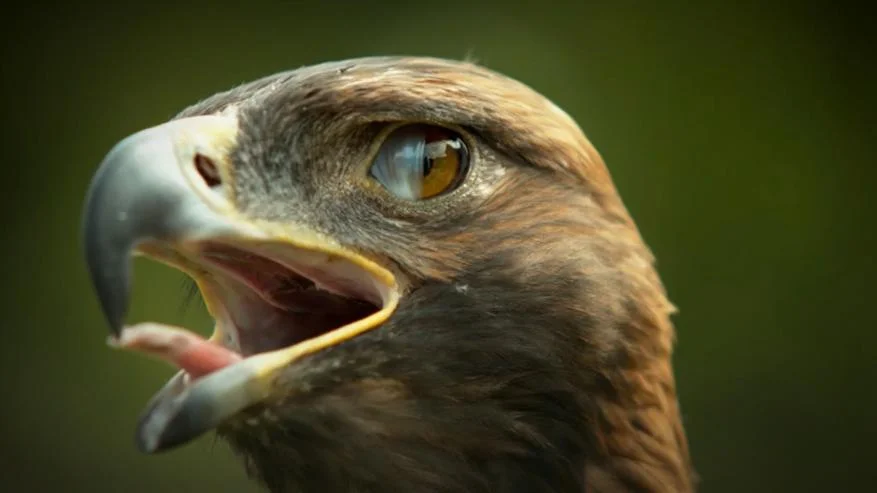
In addition, eagles have a highly developed ability to quickly adapt to changes in lighting: their pupils can dilate and contract very quickly to maintain optimal levels of eye light in all conditions. And the ciliary muscles of the eye allow them to change the shape of the lens and focus images at different distances two to three times faster than a person.
And yet, bird brains have a very complex signal processing system, not much different from human ones. However, eagles have more neurons in their visual cortex, which allows them to process visual information faster and more accurately. Moreover, eagles see individual movements, according to various estimates, with a frequency of 100 to 240 Hz. This complements their highly sensitive color and sharp vision.
And in conclusion
The vision of eagles is amazing and the more we learn about their extraordinary vision, the more clear it becomes how they became the best predators among birds. Yes, eagles have had to sacrifice good night vision, which is why they see fewer stars in the sky than we do, yes they cannot see in front of their beaks due to focusing limitations, and there are other minor disadvantages. But this does not change the fact that the eyes of an eagle are so complex and perfect that we can only imagine how they see the world.