The main protection of mollusks is their shell. But their own relatives can drill through this armor - and eat the owner alive! 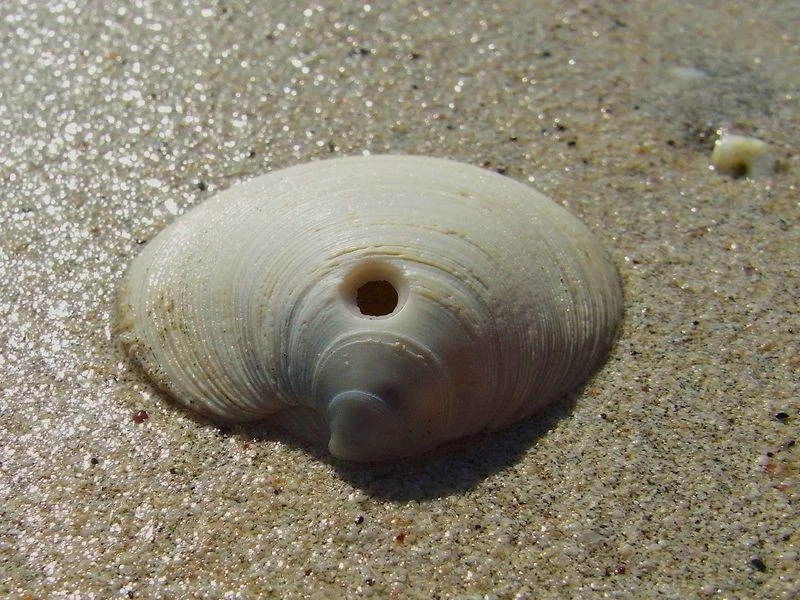
Among mollusks, the most numerous is the class of gastropods (they are also gastropods, they are also snails and slugs). There are at least 65 thousand species.
Most representatives of this class can be recognized by their shells (which, however, vary greatly in shape and size; in slugs they are greatly reduced). Gastropods also differ in food preferences. Some of them are herbivores, while others are ruthless predators, capable of defeating not only worms, other mollusks and invertebrates, but also fish. 
To hunt shellfish, some gastropods have developed a special tool - a “drill”. Its role is played by a radula, or grater, which is located at the tip of a long proboscis and has transverse rows of chitinous teeth. In some mollusks, the radula acts on the principle of a dredging machine equipped with buckets: the mollusk scrapes off food particles with it, which it then swallows. 
And those gastropods that feed on their own kind use the radula as a drill to open the shell of the prey. These are, for example, needleworts (lat. Muricidae) and sea snails Nucella lamellosa: first they secrete a secretion that softens the shell of the mollusk, and then begin drilling - this takes several hours.
If successful, the predator sucks out the flesh through the resulting hole using its proboscis. Sometimes the victim still manages to survive: this is evidenced by shells with traces of overgrown holes. Perhaps the attacker stopped drilling, underestimating the thickness of the shell or poorly choosing a particularly thick section of it - or someone scared him off.
Other mollusks - octopuses from the cephalopod class - are also capable of piercing the protective cover of the victim: with a sharp beak they make a hole in the chitinous shell, and then inject poison and digestive enzymes into it. 
Among modern gastropods, boring predators include representatives of the families Naticidae and Muricidae. Naticidae, judging by various studies, drill shells exclusively mechanically, but Muricidae also add a chemical effect to this: they use various weak acids and enzymes that corrode the victim’s shell in the drilling area. After the shell is drilled, all predatory gastropods act in the same way: they stick their proboscis inside and scrape out the prey using the same radula. In this case, mollusks can inject enzymes into the opened shell, which soften the tissues of the victim and facilitate the detachment of its muscles from the walls of the shell.
Predatory gastropods, as a rule, choose a place for drilling with skill: they drill other gastropods at a distance of one turn from the mouth of the shell (where the body of the mollusk is attached from the inside to the shell), bivalves - not far from the top of the shell (where the most fleshy part is located and adductor muscles, see Adductor muscles). 
There are, of course, mistakes: there are healed holes (that is, the victim survived the attack and repaired the hole) and unfinished drillings that do not go right through the wall of the shell (when the predator got tired of drilling into a shell that was too thick or someone scared him off).
Boring gastropods have developed cannibalism. Thus, gastropods of the Naticidae family calmly drill and kill smaller representatives of their own species (and other related species of the same genus).
Although all modern drilling gastropods appeared only in the mid-Mesozoic, the oldest traces of drilling are known from the late Precambrian. Already starting from the Ordovician, drillings very similar to modern ones become numerous (paleontologists classify them in the ichnogenus Oichnus). As a rule, they are found on the shells of brachiopods (the dominant benthic animals at that time), but they are also found on gastropods and even on the shells of nautiloids from the order Oncocerida. 
Since the drillings on Paleozoic shells are very similar to modern ones made by gastropods, researchers believe that in those distant times the drilling predators were gastropods, but they belonged to other genera and families that are now extinct. It may seem strange that sedentary, crawling gastropods could even attack cephalopods (animals that actively swim in the water column), but some Early Paleozoic orders of nautiloids, including oncocerids, lived near the bottom and, apparently, swam very slowly, and gastropods could climb onto their shells while the oncocerids rested or fed.
Of course, there is still a lot of uncertainty with the fossil traces of boring clams. It is unknown which gastropods drilled shells before the emergence of modern taxa. In addition, it is extremely rare to find several holes at once on modern shells, but such cases are quite common on fossil material. Some researchers suggest that these are traces not of predation, but of parasitism, others - that this is the result of outbreaks in the number of predators forced to literally push each other away from the small prey, or traces of erroneous attacks on already empty shells. 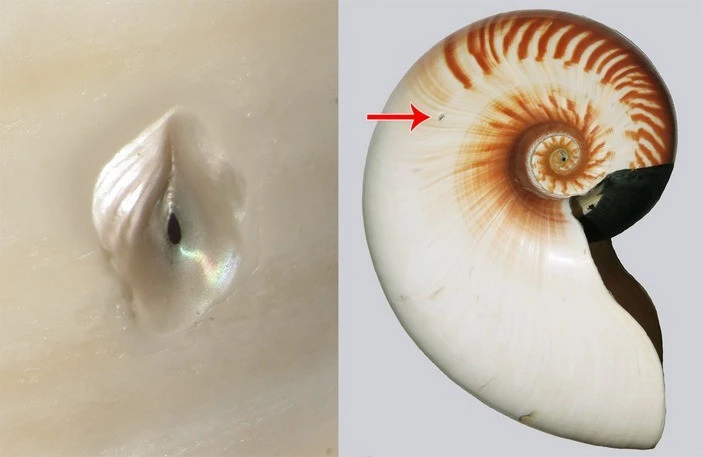
In modern seas, the drilling method for hunting is used not only by gastropods, but also by octopuses of the genus Octopus. They drill into the hard surfaces of various animals, including the shells of their distant relatives, the nautiluses. Having drilled (also using a radula) a small hole in the shell of a potential victim, they inject saliva inside, which contains a poison that can destroy the area where the muscles connect to the shell. However, they do not have a proboscis, and the radula is located between the jaws. Therefore, the hole turns out to be small and this hunting method is not always successful: researchers often come across nautiluses that have survived such attacks and have healed the drillings on their shells.
The holes drilled by octopuses are noticeably different from those made by gastropods with a characteristic oval shape (they were separated into a separate ichnospecies Oichnus ovalis) and are easily recognized in fossil material. Although the oldest octopuses are found in the Late Cretaceous (more than 70 million years ago), the oldest hole drilled by an octopus is only about five million years old. That is, octopuses most likely learned to use their radula for drilling shells and shells relatively recently (on a geological time scale).