Why American cicadas hide in the ground for decades (5 photos + 1 video)
And they appear on the surface at intervals of 13 and 17 years. Until recently, this was a mystery to scientists. 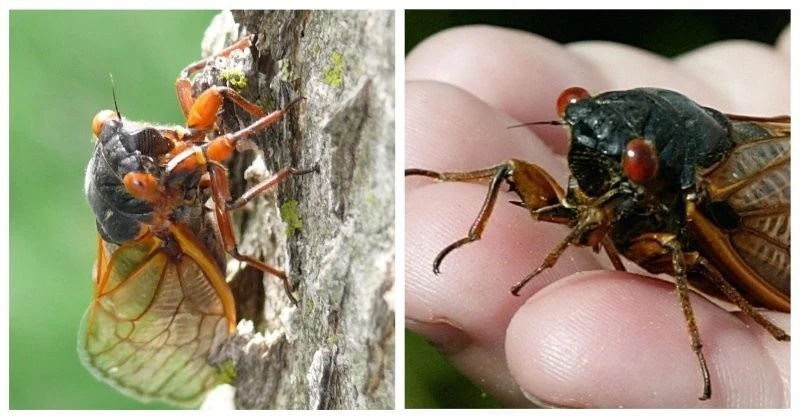
North American periodical cicadas live in forests. But the most grandiose spectacle is their mass appearance in the groves. Even as you approach it, you can hear a powerful hum; up close it can reach 100 decibels, approximately like the sound of a fighter jet.
The entire ground is dotted with holes through which cicada larvae climb to the surface. The surface is strewn with heaps of discarded skins, and their former owners are sitting on the trees. This is a real feast for animals - everyone from chipmunks to bears comes to feast on the cicadas.
In general, there are plenty of cicadas in warm regions; in the eastern United States, they appear every year. But the uniqueness of periodic cicadas lies in their life cycle: they live underground for 13 and 17 years and emerge to the surface only at the end of this cycle.
The Indians were well aware of these periods when cicadas hatched from larvae; they even had several insect dishes. At first, European colonists were busy with completely different things and did not care about cicadas. They became seriously interested and began to be studied only in the 20th century.
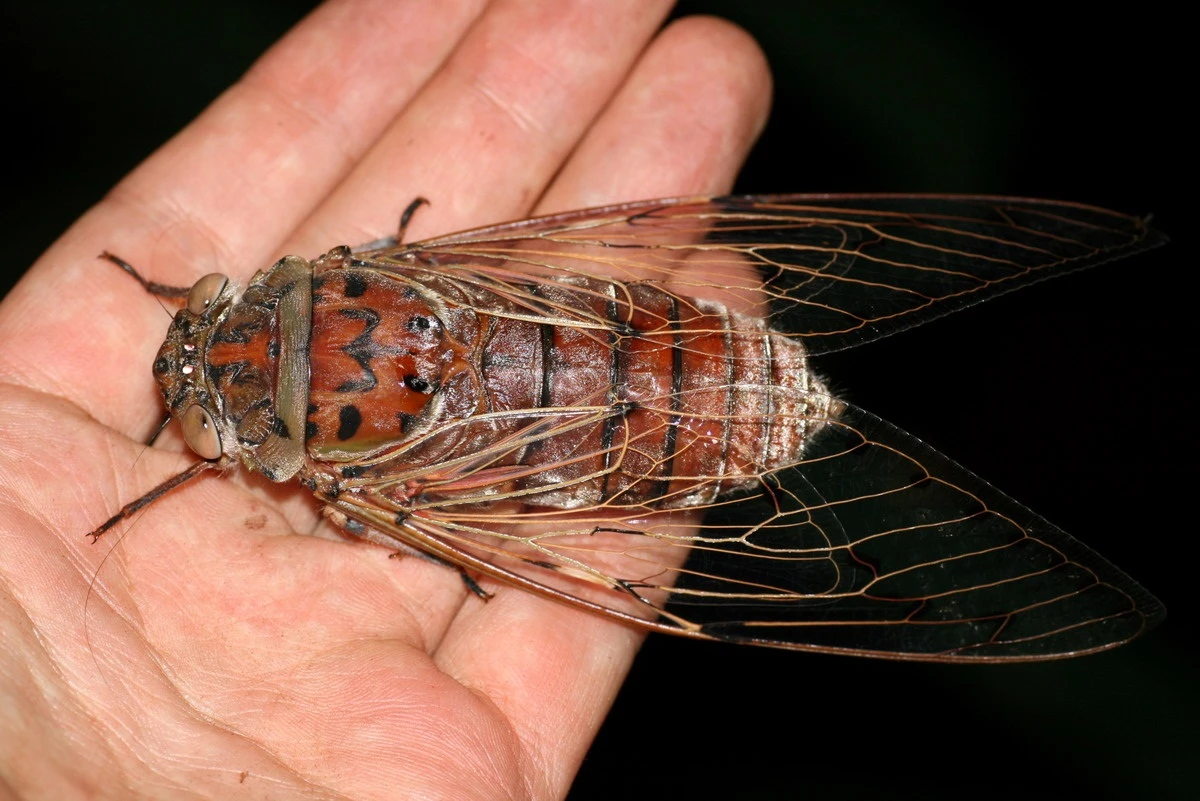
Today, four 13-year and three 17-year species of cicadas are known, all emerging at the same time. They feed on tree sap and reach it using a sharp proboscis. Adults extract it from young branches, and larvae from roots, to which they dig tunnels up to 10 meters deep. Males crawl into the treetops and begin singing to attract a female. Sound is produced using vibrating membranes on the abdomen. When a female appears, she begins to twitch her wings invitingly and the fastest male manages to fertilize her.
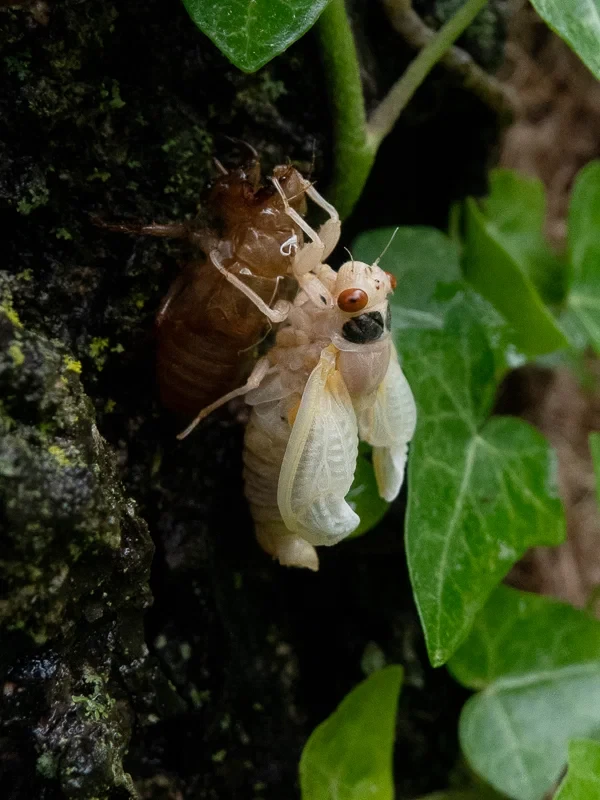
The female then lays up to 500 eggs in cuts in the branches, from which the larvae hatch, fall to the ground and bury themselves. Accordingly, they live underground for 13 and 17 years (depending on the species), and then come to the surface. They do this only when the ground warms up to 18 degrees - then they come out of the ground, shed their skin and climb the trees.
Most of all, scientists were interested in the periodicity of cicadas. It was obvious to them that this was protection from a predator who could not adapt to such a long cycle. But its timing raised questions. In the end, they came to the conclusion that there used to be populations of cicadas with different cycle lengths. To protect against predators and parasites, it was advantageous to have as long a cycle as possible, so cicadas in which it increased as a result of mutations avoided hybridizing with the others. This evolution continued over a million years.
In general, this development option worked - periodic cicadas really do not have a predator that feeds only on them. But we encountered a parasite. Cicadas are infected by the fungus Massospora cicadina, which grows in the abdomen of the males and makes them infertile.
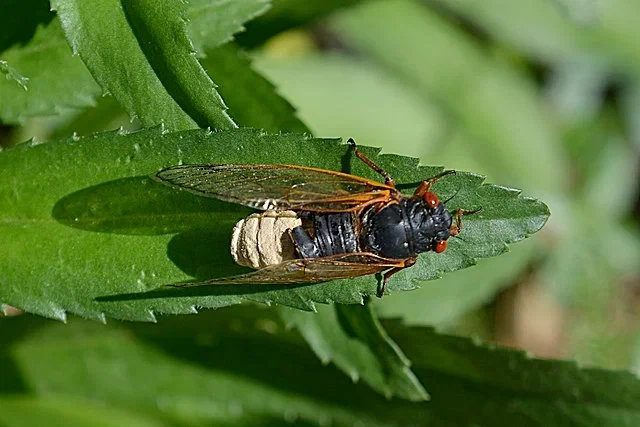
At the same time, males first try to mate with females, infecting them, and then begin to “deceive” other males, imitating the rustling of the females’ wings. Healthy males gather at this sound and it infects them. After some time, the cicadas begin to drop fungal spores on the ground and there it infects the larvae. They remain asymptomatic all their years underground; the fungus only appears when they become adults. And a new circle of disease begins.
Scientists have even isolated psychoactive substances that the fungus secretes to change the behavior of males. They have only just begun to be studied, but it will be interesting if they can influence other animals.

Later it turned out that periodic cicadas seriously affect nature. Two years before their appearance on the surface, cicada larvae begin to intensively suck juices from the roots. As a result, tree growth rings decrease and oaks do not produce acorns. Because of this, the number of squirrels decreases, but the number of moles that eat the grown larvae increases. When the larvae come to the surface, many birds feed more chicks, and the number of moles, on the contrary, falls because the new larvae are still too small to serve as food for them. In nature, everything is interconnected.
Now the cicadas are doing well; they are only hampered by climate warming. Because of it, they can mistakenly crawl out of the ground ahead of schedule and die. In the future, they are threatened by deforestation, although developed countries have begun to pay more attention to the remaining forest areas.
Therefore, periodic cicadas, this natural miracle, have an excellent chance of continuing to survive and thrive.