Common jackal and interesting facts about it (11 photos + 2 videos)
Let's continue to get acquainted with the heroes of the Soviet cartoon "Mowgli", yesterday there was a tiger, and today his constant companion, the jackal Tabaki, who, by the way, is absolutely different from his real prototype. (Who is too lazy to read the video below) 
First, a little biology:
The common or Asian jackal (lat. Canis aureus) is a mammal from the canine family.
Compared to other members of the canine family, jackals are small animals, about the size of a mongrel. The body length is approximately 80-130 cm, the tail is 25-30 cm, the height of the predator is 40-45 cm. The mass of the common jackal is 8-12 kg.
The structure resembles a lean wolf - a dense body on thin legs. The front paws have 5 toes, the hind paws have 4, and the claws are blunt. The jackal always has a drooping tail, the size of which is approximately one third of the body length. The thick and shaggy tail hangs almost to the ground. 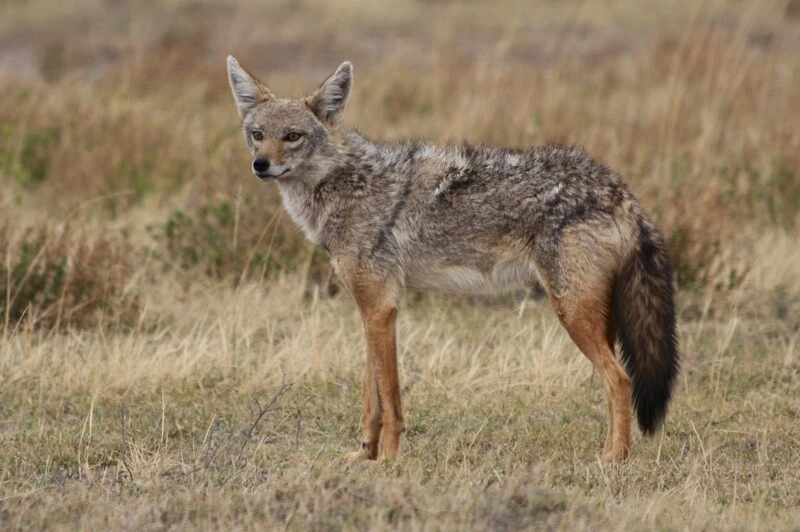
Small wedge-shaped head. The animal's muzzle is pointed. Ears are erect. Animals' hearing is well developed, helping to detect small rodents in dense grass. Sharp fangs are adapted to chew through thick skin. There are 42 teeth, like all representatives of the genus Canis. The predatory teeth and fangs of the jackal are less developed than those of the wolf. Jackals have well-developed vision - they see excellently both during the day and at night. Eyes with brown irises. The sense of smell and hearing, in turn, are also excellently developed. 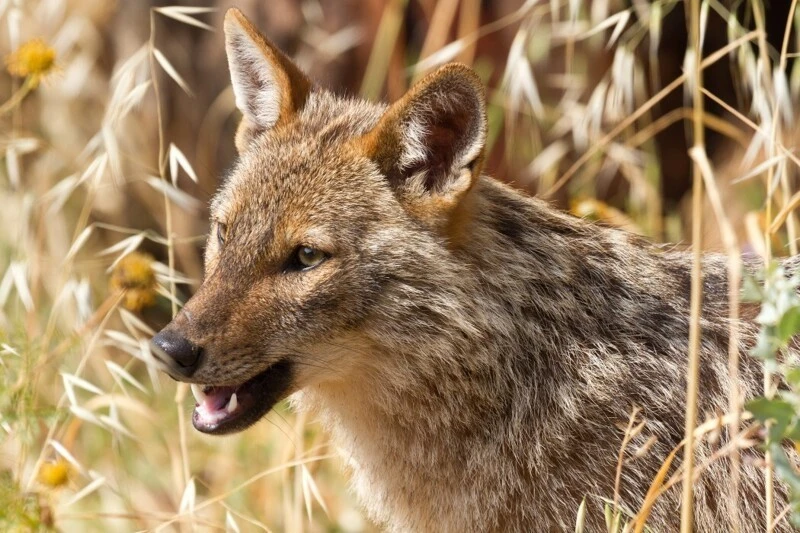
Animal fur is coarse and tough. The color is variable and differs significantly depending on the habitat. Yellow-red tones predominate, turning into brown. The back and sides are dark to black, as is the tip of the tail. Throat, belly, legs are light shades. There are no gender differences in color. Summer fur becomes shorter and coarser than winter fur. The jackal molts twice a year - in spring and autumn, the spring molt begins at the end of winter. If the winter was warm, the spring molt begins in mid-February; if the winter was cold, it begins in mid-March.
The jackal is very loud and vociferous. Before going out to hunt, the animal emits a loud howl, similar to a high, whining cry, which is immediately picked up by all other individuals nearby.
The ancestor of the jackal is considered to be the extinct species Canis arnensis, which existed about 1.9-1.6 million years ago in the Mediterranean region. During the last Ice Age, jackals survived in Southeast Asia and India, from where they supposedly migrated west about 15-10 thousand years ago.
The jackal is distributed throughout India and in the regions to the west of it - in the Near and Middle East, Central and Asia Minor. In Europe in the mid-20th century, it was found only in the Balkans: Greece, Albania, Bulgaria and Yugoslavia. The animal was so rare that in Albania and Serbia, and since 1962 in Bulgaria, hunting for this species was completely prohibited.
Despite the fact that the jackal is the closest relative of the wolf, it is more of an omnivore than an active predator. Depending on the time of year, it feeds on what is easier to obtain. In winter, the jackal often feeds on carrion, but with the arrival of spring, the percentage of carrion it consumes decreases. At this time, he often feeds on rodents (including muskrat), insects, berries, etc. In general, as noted above, the jackal is an omnivore. Among the food consumed by the jackal, in addition to those already mentioned, drupes of oleaster, melons, reptiles, amphibians, fish, invertebrates, etc. should also be mentioned. A jackal can sometimes steal domestic chickens, but does this much less often than a fox. Accusations of a jackal stealing lambs are usually not justified. The jackal is a highly developed animal; it is not only smart and cunning, but also very dexterous and agile. In a high jump, he can grab a bird that has already risen into the air. The jackal conducts its hunting search at a small trot, often stopping to sniff and listen. Where there are large predators, jackals follow them to take advantage of the remains of their prey, snatching scraps right from under their noses. 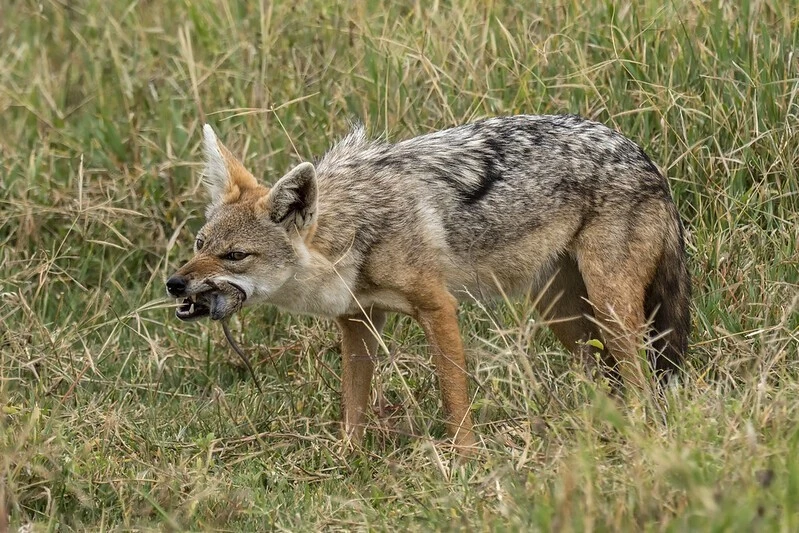
Like the vast majority of representatives of the wolf subfamily (Caninae), the jackal lives in pairs or alone. This is a monogamous animal that forms long-term (at least one breeding season) and sometimes permanent pairs. Jackals also usually hunt in pairs for more or less large animals.
Female jackals come into heat once a year, which is typical for wild canids (domestic dogs usually come into heat twice a year). The resulting pairs build a den together and raise their offspring. Preparing a home involves finding a hole or digging your own. The depth of the shelter is approximately 2 meters. The passage is located at an angle and ends with a nesting chamber.
Pregnancy lasts approximately 60-63 days, which is typical for the canine family. The female usually brings 4-7 cubs. Feeding with milk lasts up to approximately 45 days, and already on the 20th day of life, puppies already begin to eat meat brought by their parents. 1.5-2 month old jackal cubs are already learning to hunt together with adults. Jackals reach sexual maturity at 9 months, but males usually begin to take part in breeding after a year. 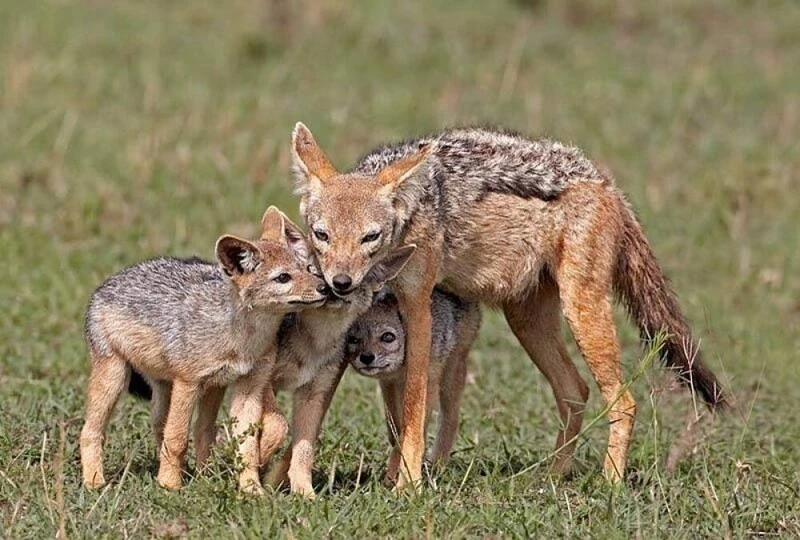
Jackals in Europe have almost no enemies. The exception is wolves, but their populations are small and fragmented. The situation is different in Asia. Among the main enemies are domestic dogs, which attack jackals if they come too close to human habitations, or striped hyenas. In the Jim Corbett Indian National Park, pythons are mentioned as a major enemy. They have had conflicts with tigers in the past, but the tiger population is in constant decline and therefore there are no conflicts with jackals. The traditional enemies of jackals are leopards.
Its main food competitors are wolves, foxes and swamp cats, raccoons in the Caucasus and steppe cats in Central Asia.
The lifespan of jackals in the wild is usually no more than 14 years. 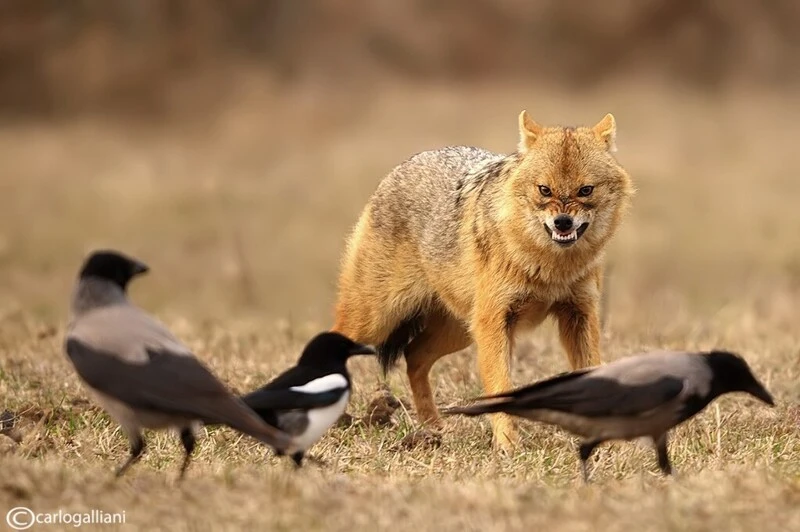
Modern expansion in Europe
In the USSR, the jackal was traditionally found in Turkmenistan, Transcaucasia and southern Dagestan. In the 1950s, a visit by the Balkan jackal was recorded near the city of Soroca in Moldova. In 1982, the jackal entered Hungary, from 1987 it reached Italy and Austria, from 1989 it invaded Macedonia, Romania, Slovakia and the Czech Republic, and in 1997 it entered Ukraine, becoming a new species for it. In the 21st century he mastered Hungary and Poland.
The animals have also been spotted in Germany (since 1998) and Switzerland (since 2011). In the Black Forest, golden jackals breeding in Germany was recorded for the first time in 2021. There have also been sightings in the Netherlands. The northernmost observation points were in 2015 in Estonia and Denmark. In July 2019, a jackal was spotted for the first time in Finland.
On December 31, 2011, the first case of a jackal being found on the territory of Belarus was recorded. In November 2018, a golden jackal was recorded in the north of the republic.
Original habitat 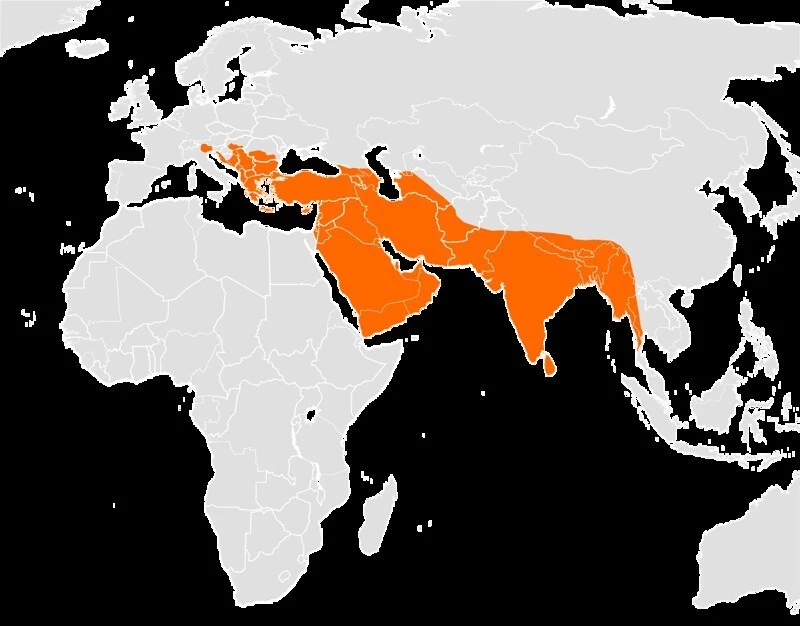
Jackals were first spotted in Estonia, Latvia and Lithuania in 2013. Some zoologists believe that they came from the territory of Ukraine through Belarus. Another is that jackals spread from the Estonian nature reserve. In Estonia, 64 jackals were killed in 2019.
Jackals are widespread in Central Asia (southern regions of Kazakhstan, Uzbekistan, Kyrgyzstan). When the jackal population threatens the extermination of pheasants, rabbits and other non-predatory animals, this species is shot in the fall to artificially reduce the population.
Modern range (2020) 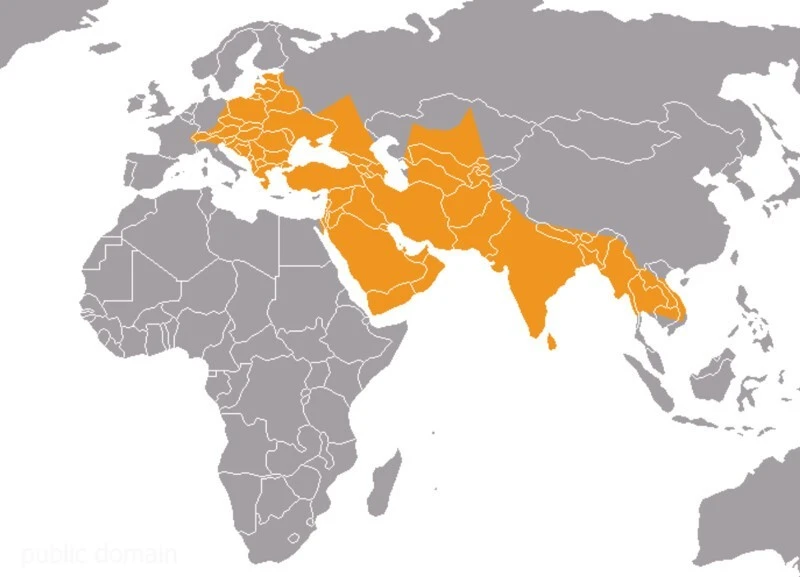
Back in 1998, this species entered the territory of Ukraine. Moreover, the territory of Ukraine was invaded in two independent directions: from the southeast from Southern Europe and from the southwest through the western steppes from the Caucasus. Now the jackal has appeared in the Donetsk, Odessa, Nikolaev and Kherson regions of Ukraine. Although in this region its range is still patchy and highly fragmented, by the middle of the 21st century the jackal will probably colonize the entire Northern Black Sea region, the Azov region and the Ciscaucasia.
Interesting Facts:
- It is known that in India, lonely jackals, expelled from their pack, enter into commensal (companionate) relationships with tigers. These solitary jackals, known as kol-bal, associate themselves with a particular tiger, following it at a safe distance to feed on the big cat's prey. So, the character of Tabaka was drawn, one might say, from life.
- The Romans called the jackal the golden wolf. Hence its Latin species name aureus, meaning golden.
- The ancient Egyptians always depicted the god Anubis with the head of a jackal.
- The common jackal is the largest of the three species of jackals.
- The oldest finds of jackals in Europe were found in Delphi and Kitsos and date back to 5000-4500 AD. BC.
- The jackal swims well and sometimes catches fish in shallow water. 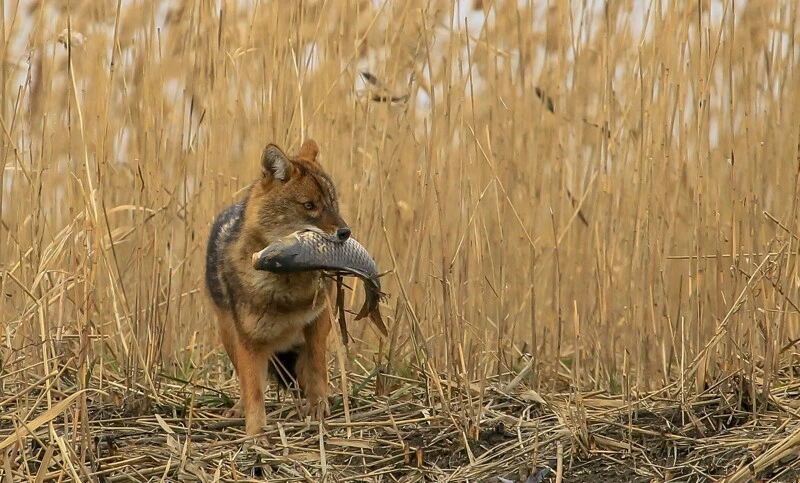
- Genetic studies have shown that the common jackal is more closely related to the wolf than even to other species of jackals, which are classified in the subgenus Thos
- There are 12 subspecies of golden jackal
- The jackal is thermophilic, so its settlement in this untraditional region for it can serve as confirmation of climate change
- In India and Pakistan at night he can often be seen wandering the streets of villages and even cities. If large cities in South Asia have large green areas, then jackals almost certainly live there.
- Jackals inhabit the suburbs of Sochi, and in hungry years they appear in the city itself. Jackals come to the city from the forest next to the Arboretum in the Fabricius microdistrict in the area from the Start Hotel to the Tree of Friendship, jumping into garbage cans along the way.
- Jackals can withstand frosts down to -25 degrees or more, but are not adapted to deep snow 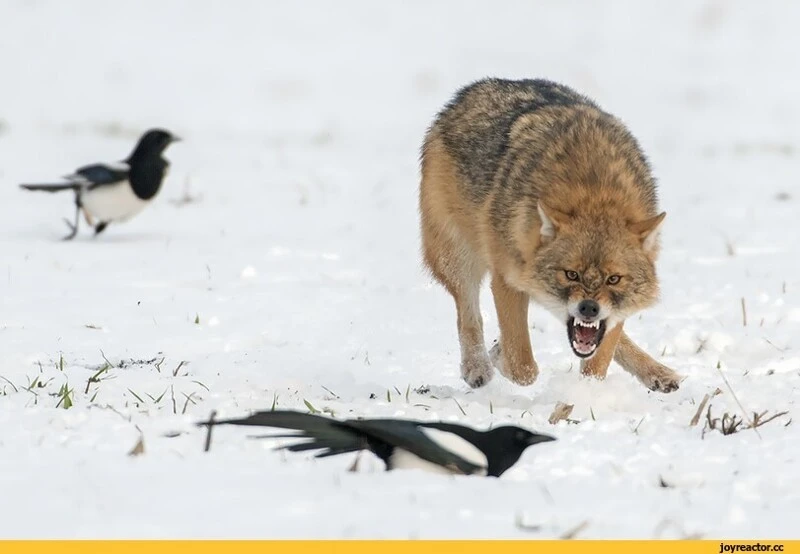
- Long considered a subspecies of the European jackal, the African wolf was identified as a separate species based on the results of a genome study conducted in 2015
- Of the representatives of the canine family, the domestic dog and coyote are closest to the jackal, which have a similar number of chromosomes
- In the 1940-1950s, jackal fur was harvested in the USSR. It is suitable for edging men's winter clothing.
- The jackal is perfectly tamed. It is not without reason that in the distant past he apparently gave rise to some breeds of domestic dogs
- In India, there have been cases where jackals observed wolves while hunting, and then fed on their prey without any signs of wolf aggression.
- The Aeroflot company does not use dogs to inspect luggage for possible detection of explosives, but a cross between them and a jackal, Sulimov’s dogs. This “breed” is jokingly called “Shabaka”. The Shabaka is said to have a better sense of smell than the average dog 
- In the Indian states of Gujarat, Rajasthan and Tamil Nadu, the Koli and Narikurava people hunt the Asian jackal and consider its meat a delicacy.
- The nickname “Jackal” was worn by the famous international terrorist Ilyich Ramirez Sanchez.
- Genetic analysis shows that mating sometimes occurs between female jackals and gray wolves, resulting in jackal-wolf hybrids that experts cannot visually distinguish from wolves.
Well, as usual, for those who are too lazy to read