Is it possible to meet a wild monkey in Europe? The answer “No” will generally be correct. Representatives of the order of primates are common in Africa, Asia, and America. But in Europe, as well as in Australia, monkeys do not live. With one single exception - a small colony of Magoths, representatives of the genus of macaques of the marmoset family, who settled on the rocks of Gibraltar in the south of the Iberian Peninsula. (Who is too lazy to read, video at the end)
First, a little biology: 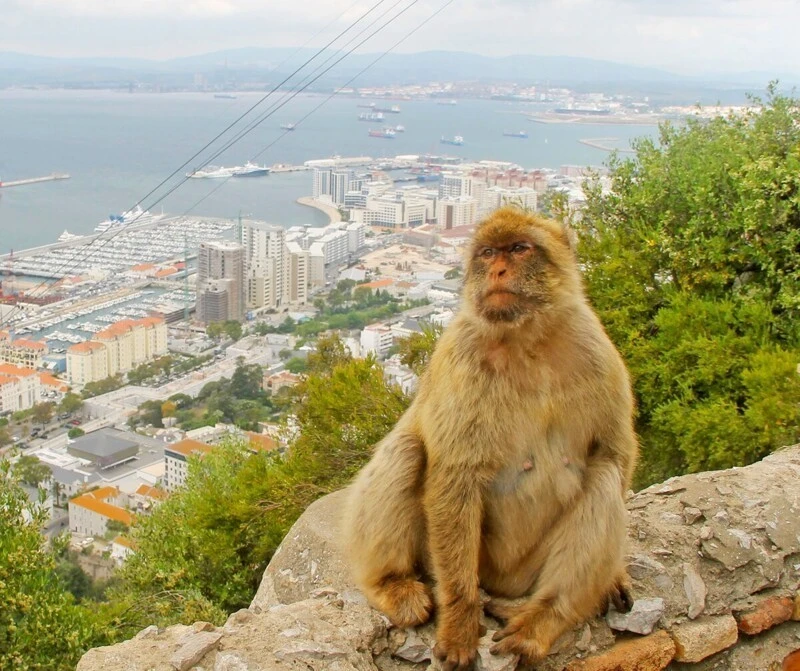
The Magot, or Barbary monkey (lat. Macaca sylvanus) is the only monkey living wild in Europe (in Gibraltar). In addition, the Magot is the only macaque that does not live in Asia.
Magots are distinguished from other representatives of the genus primarily by the absence of a tail. The body length of adult males of this species is 55–60 cm, weight is about 15 kg. Females are slightly smaller - usually no more than 11 kg. The Magots have a slender build, long, thin limbs. The coat is colored reddish-olive. The hairless, wrinkled muzzle is decorated with thick sideburns. Like other macaques, magotes live in groups of 10–40 animals. Each group occupies a permanent territory where the monkeys gather food and rest. 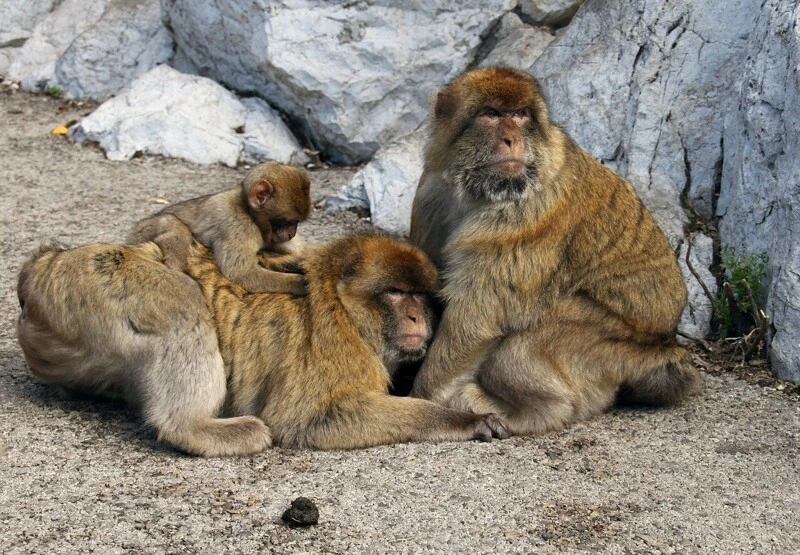
The group occupies land over an area of three to five square kilometers. Several families can live on one plot. The magot roosts not only in dense branches but also on mountain slopes. During the solstice, they slowly move around their lands in search of food. Most often they walk on all fours, and only stand on their hind legs if they want to look around. In Magoth groups there are relatively many adult males, between whom there is a strict hierarchy. The social status of the alpha male is established only on the basis of voluntarily expressed consent by adult family members. Males willingly tinker even with other people's cubs and often carry their chosen favorite among the kids everywhere with them. The male cleans it, entertains it and shows it to his comrades. 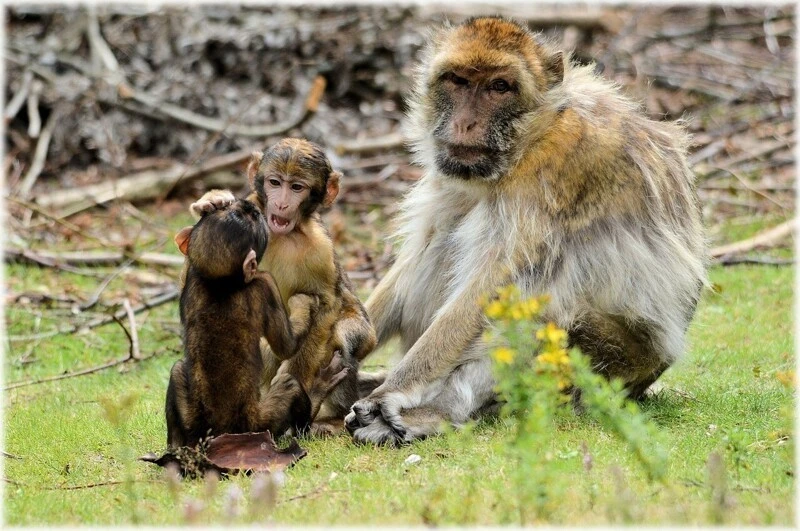
Cubs also serve as “white flags” - their display reduces enemy aggression.
Magots live in pine, cedar and oak forests, where they feed on fruits, edible roots, cereals, buds, shoots, seeds of coniferous trees, and some insects.
These primates are common in the Atlas Mountains (Algeria, Morocco and Tunisia) and Gibraltar. Animal habitats in the mountains reach an altitude of 2300 meters above sea level.
The mating season among the Magoths lasts from November to March. During the breeding season, the female chooses a partner who demonstrates good paternal qualities. Pregnancy among Magoths lasts 5.5 months, and newborns weigh about 77 g, becoming sexually mature at 4–5 years of age. At the age of a week, the cub already learns to run, but prefers to travel long distances on the mother’s back. Milk feeding ends after 3 months. 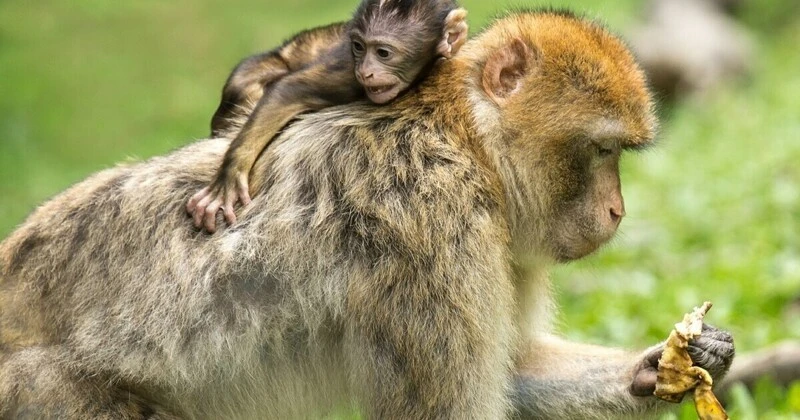
Interestingly, females live longer than males. There have been cases where females have lived up to 30 years of age, while males rarely survive 25 years of age.
Interesting Facts:
- In the early Quaternary period, representatives of this species lived almost throughout Europe, but then almost completely disappeared with the beginning of the Ice Age.
- They are able to withstand frosts down to -10°C, thanks to their thick fur.
- This species of primate was declared endangered in 2009.
- All Gibraltar Magots come from the North African colonies of these monkeys. Evidence obtained through DNA analysis has unequivocally confirmed that the existing population of the Magoth colony is of relatively recent Algerian and Moroccan origin. No traces of a “third source” in their DNA, namely the ancient, no longer existing Iberian population, were found. An earlier theory, now refuted by DNA research, was that the original Gibraltar Magots were a remnant of a population that spread throughout southern Europe during the Pliocene until about 5.5 million years ago. In any case, their presence is recorded on the Rock of Gibraltar before it was captured by the British in 1704. Magots were brought here, most likely by the Moors (who controlled Iberia or parts of it, including Spain and Portugal, between 711 and 1492), who used them as pets.
- The history of the Magots from Gibraltar is very interesting. In 1855, the Gibraltar Magoths were taken into custody by the British Navy. A special officer monitors their integrity. On the territory, the magot receives not only feeding, but also treatment and protection. Despite guardianship, in 1858 the colony was overtaken by an epidemic, as a result of which almost all the individuals died, leaving only three monkeys alive. Despite this, the governor of Gibraltar ordered the importation of new African primates. The magot felt another replenishment after the Second World War.
- As the legend goes, when the last monkey disappears from the rocks of Gibraltar, British rule over them will come to an end. 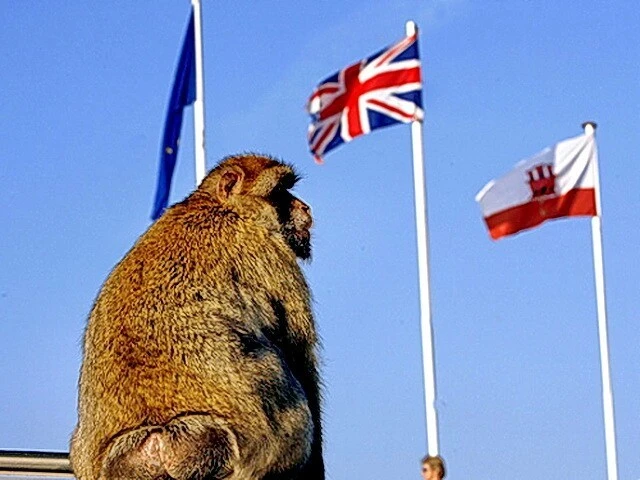
- The Gibraltar population of magots consists of about 230 monkeys who live in six groups.
- Feeding the Magoths in Gibraltar is now a crime punishable by law. Anyone caught feeding monkeys faces a fine of up to £500.
- Legend has it that Gibraltar is connected to the African Hercules Caves by an underground passage more than 24 kilometers long, which begins at the bottom of St. Michael's Cave and passes under the Strait of Gibraltar. Legend has it that the Magots came to the Rock of Gibraltar from Morocco in this way.
- Magoth is depicted on the Gibraltar 5 pence coin. On the other side is Queen Elizabeth II. 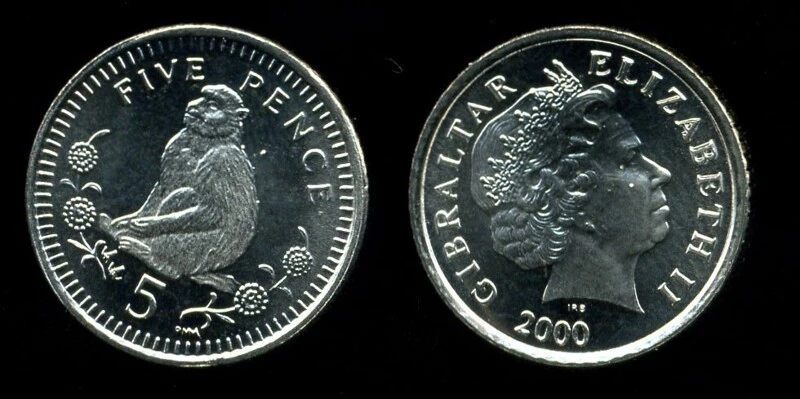
- The Affenberg nature park in the vicinity of the southern German city of Salem is famous for its monastery. Several families of macaques live practically free in this park. Their freedom of movement is limited only by a high fence, which is inaccessible for animals to overcome.
- King of the Greeks in 1917-1920 from Alexander I of the Glucksburg dynasty, on October 2, 1920, while walking in the royal garden of Tata, he was bitten by a magot, from which he was protecting his shepherd. Three weeks later, on October 25, he died of sepsis.
- During excavations in 2003 at the Rurik settlement in Veliky Novgorod, a large fragment of the skull of an adult female Magot was discovered, radiocarbon dated by the microdose method (AMS method) to the period between 1160 and 1220. This discovery of the remains of Macaca sylvanus is so far the oldest for this era on the continent of Europe.
0 comments