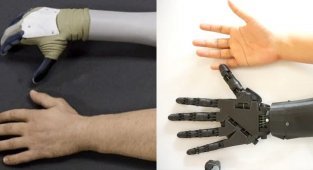
When we hear about cyborgs, science fiction films come to mind. And many don’t even think that the time of terminators has already come and cyborg people have become a part of our society. 
Dentures have been around for a very long time. They are believed to have appeared in the Middle East around 3000 BC. However, significant changes in this area began only in the 19th century. From that moment on, prosthetics performed not just a cosmetic function, imitating a lost limb, but also somehow complemented the owner. For example, instead of an ordinary palm, they could attach some tools, tongs or a hook, or something useful for work. 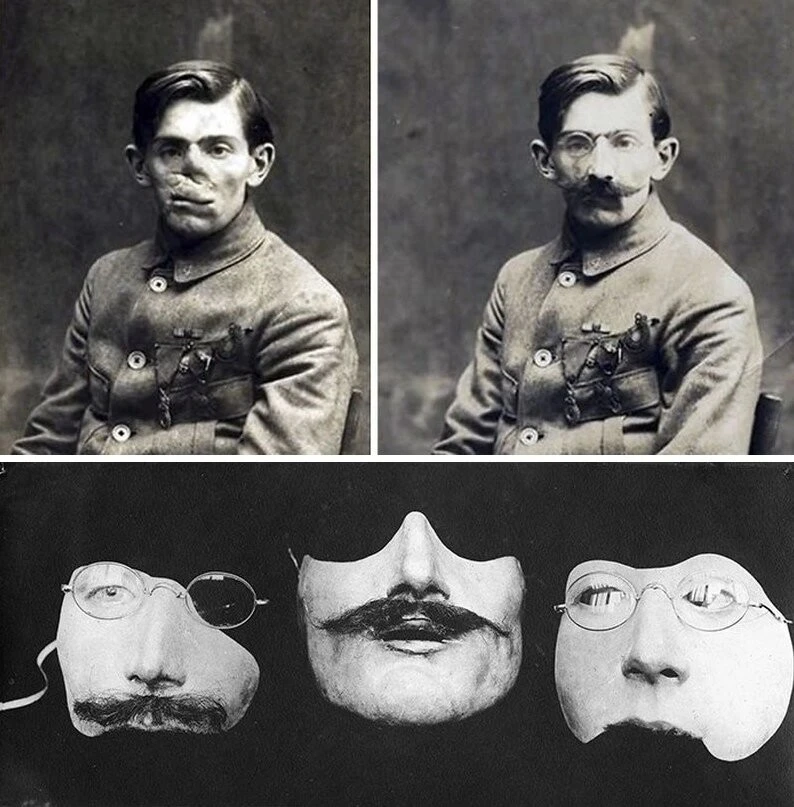
During and after the First World War, the field of prosthetics understandably experienced a real boom. Those times played a significant role in modern prosthetics. Today, prosthetics can be equipped with a whole set of replaceable elements, for example, you can attach a hammer, a key, scissors, a chisel, and so on. There are even special sets for housework, sets for storing instruments, writing instruments, irons, sewing machines, and drawing tools. In short, everything a person might need. With the development of technology, prosthetics are also becoming more advanced. Today you can make not just a stationary imitation of a limb, but almost anything.
Here, for example, are several options for what you can use to replace an eye!
Brian Stanley 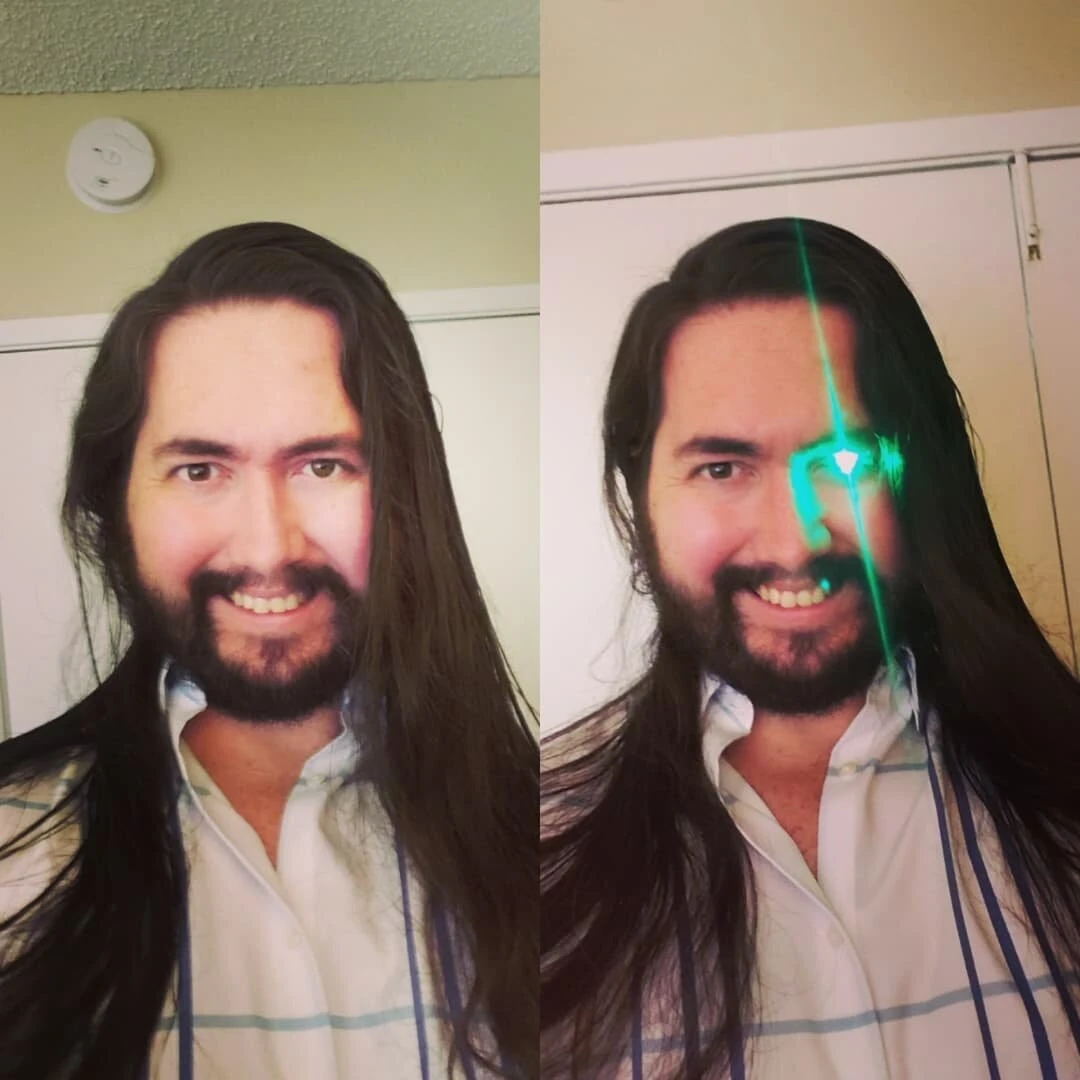
When Brian Stanley, an engineer from California, lost an eye to cancer, he decided not to settle for a conventional prosthesis. The guy turned a fake eye into a flashlight. And it looks so cool that it’s even hard to believe. But the invention is real! The man literally turned himself into a cyborg. So far this, of course, is a rather primitive version, not at the cyberpunk level. But impressive for 2022. The flashlight eye perfectly illuminates the area directly in front of him, that is, the place where Brian turns his head. Brian himself calls his invention an intracranial titanium light bulb. The inventor also notes that this is a great thing for reading in the dark. We think the invention is no less useful late at night, when you need to return home alone, when you need to go down to the basement, or find things in the far corner of the closet. 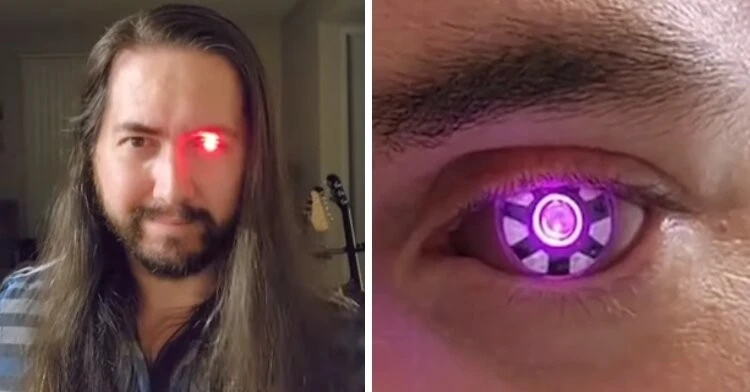
The flashlight is activated by a proximity sensor. The first thing we thought was that the eye must be getting very hot. In addition, it is located close to the brain, and this can be dangerous. But Brian claims the eye doesn't get hot at all, and the battery can last up to 20 hours. Its intensity is also adjustable, for example, you can turn on the high beam.
Brian experiments with colors and even pupil shapes. For example, last Halloween he made pupils in the shape of ghosts and pumpkins. This year he made the amazing eye of Jack Skellington (the hero of Tim Burton's poem "The Nightmare Before Christmas". He could cosplay the T-800! The courage and ingenuity of this guy is respectable. Modify your body like this yourself! But you know, a flashlight instead of an eye, This is not the coolest thing you can come up with.
Rob Spence 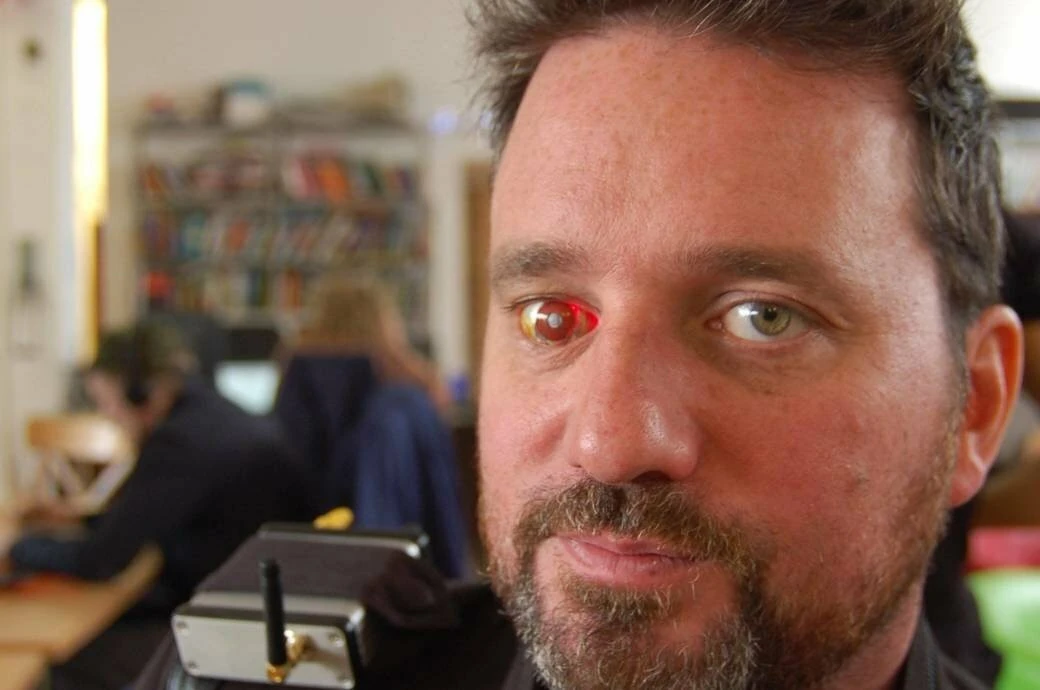
Rob Spence installed a camera in his eye socket! It all started when Rob was a child. He was blinded in one eye due to a shotgun accident. Several years ago, the injured eye began to swell, and the cornea was severely damaged. Doctors said that the eye would have to be removed. That's when Rob came up with the idea to create a tiny camera that could replace the eye and record everything it sees.
Rob contacted several camera manufacturers and engineers and quickly realized there was something to this idea. The engineers were only too happy to design a tiny camera. After all, this is the first time people would do something like this. It would make all the headlines! And they made a camera. 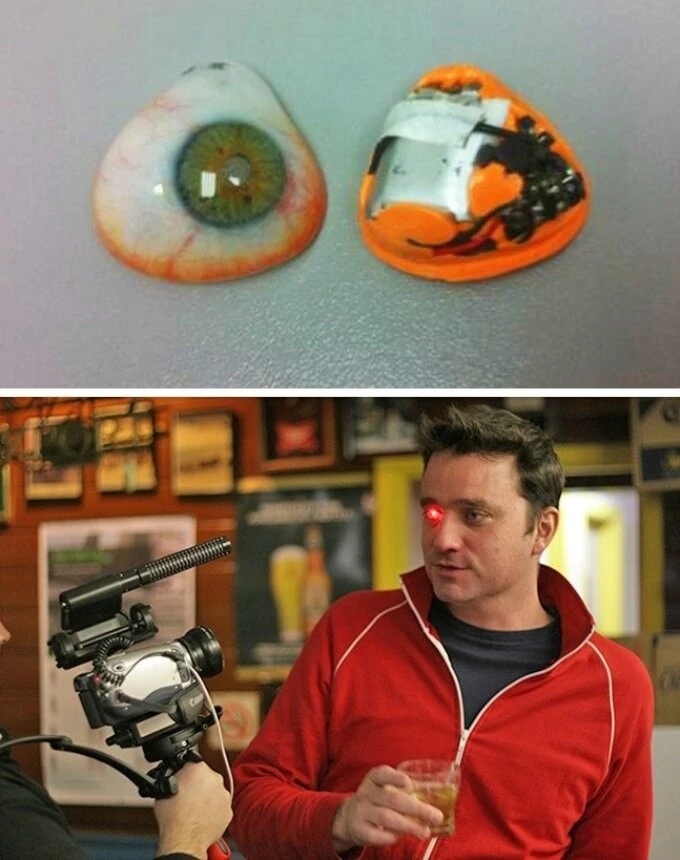
Thanks to its miniature transmitter, it uses an analog rather than digital signal. Everything that the camera records can be broadcast on a screen, for example, on a TV.
Of course Rob doesn't use the camera all the time, it's pointless. The battery charge lasts for 30 minutes at best. So with the eye camera, Rob can make short films.
And again, having a bionic eye, it’s difficult to resist trying on the image of some famous cyborg. Over the years, Rob has created several versions of the eye, from a red one like the T-800, to a camera with a transparent shell that allows you to see the inside of the eye.
Well, enough about the eyes! Let's look at unusual prosthetic hands, they may also impress you.
James Young 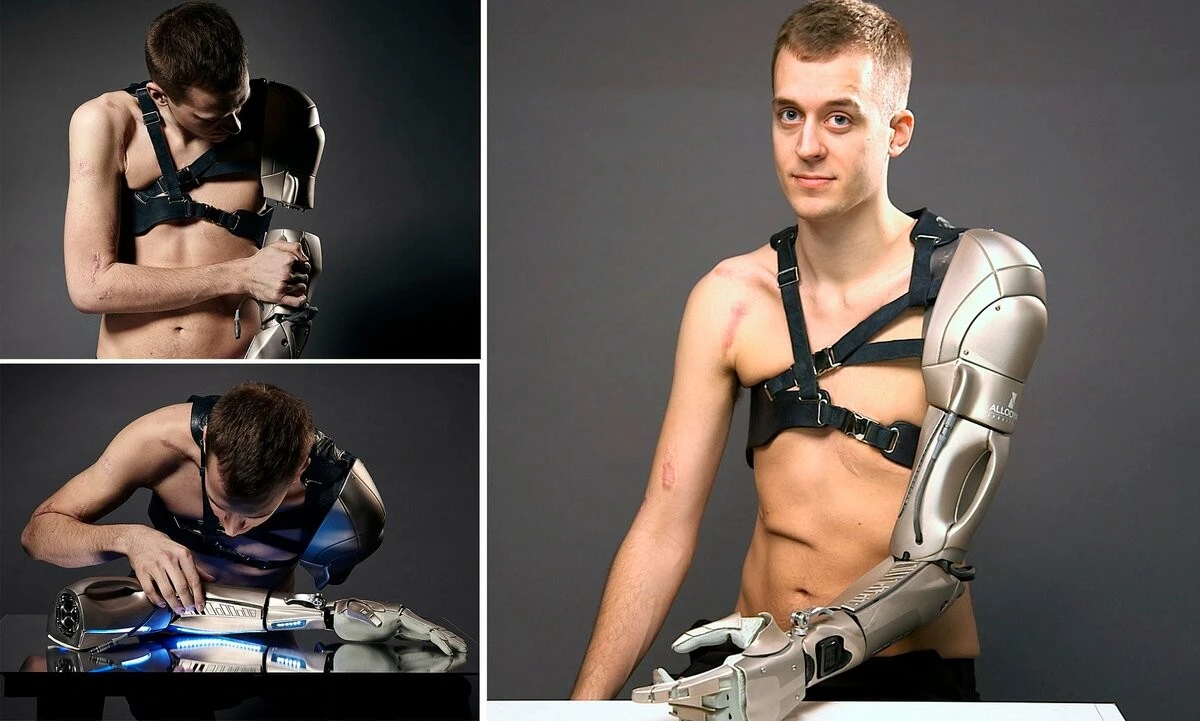
Meet James Young. About 10 years ago he found himself between two train cars. The incident cost James an arm and a leg. For some time, the injuries completely disabled the guy, both physically and psychologically. But video games helped him cope with all his problems. Before the accident, James was a gamer, and even after losing his limbs, he was still able to play PlayStation 4 with his right hand and, surprisingly, with his teeth. Yes, James was truly dedicated to gaming.
James's story is quite well known. He was chosen from 60 applicants who wanted to receive a fantasy prosthetic device inspired by the game Metal Gear Solid from Konami, a leading video game developer.
This is not just a prosthesis, it is 70 thousand carbon fibers controlled by James' muscle signals. 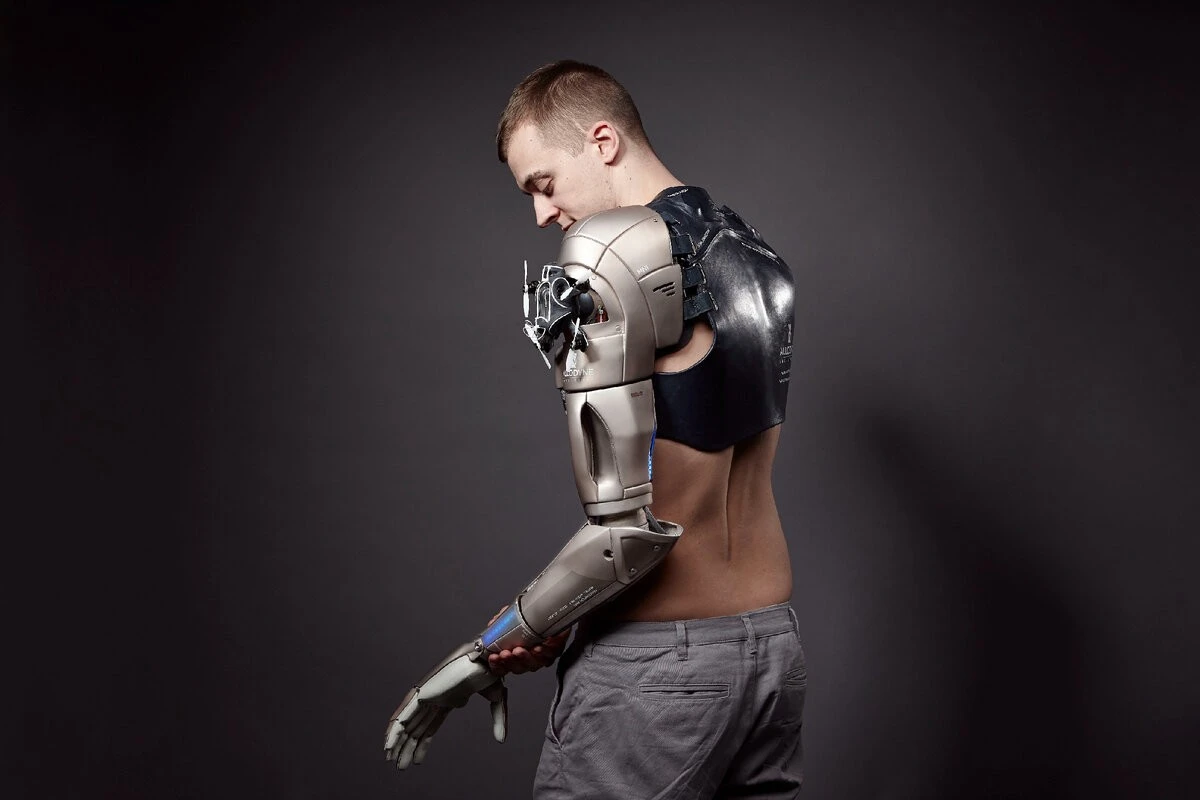
With the help of a prosthesis, he can shake hands, lift groceries and even collect coins. In addition, the prosthesis is equipped with an interactive screen, a flashlight, a USB port and even a drone! All this is powered by a battery.
James says it's impossible to walk all day with a 10-kilogram arm tied with special straps. Although the average human hand weighs about the same. But the guy obviously knows better.
You're probably wondering why a robotic arm needs a drone?! We don't have an answer to this question. But anyway it looks cool. The further prosthetic technology advances, the more unique prosthetics become. 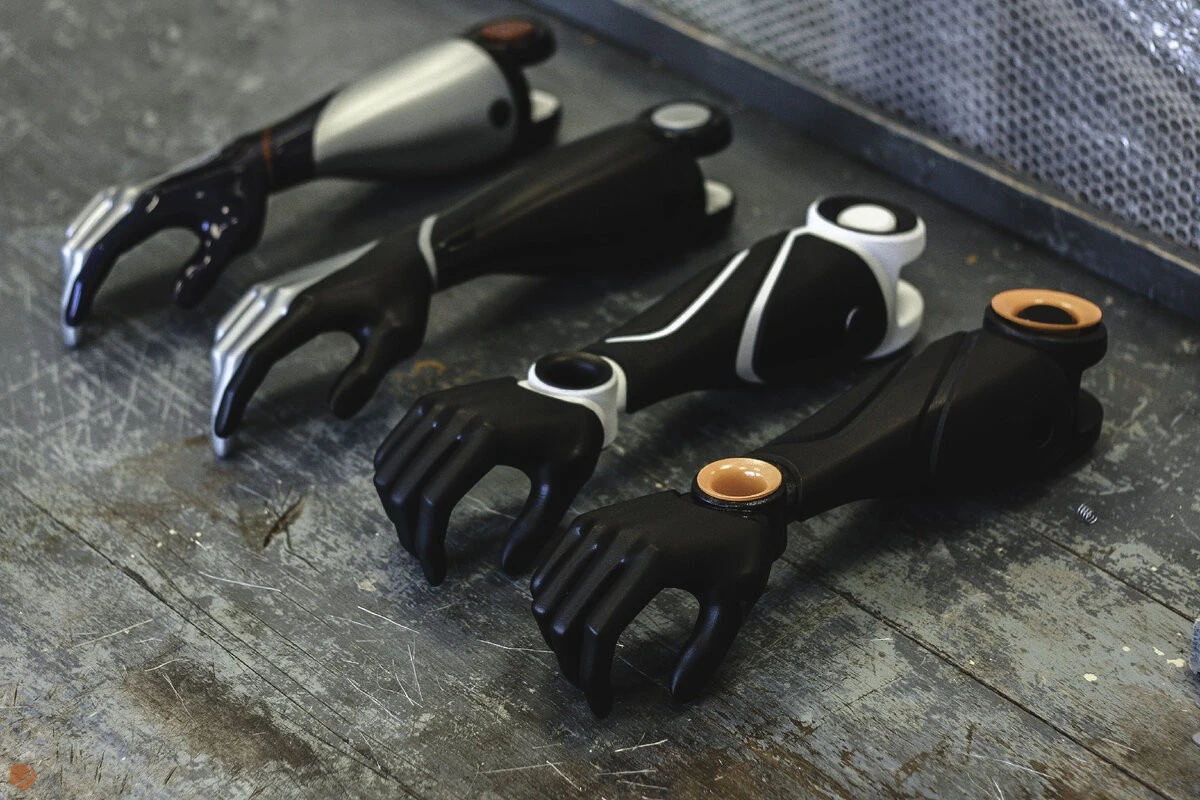
The Polish company Glaze Prosthetics produces designer prosthetic hands using a 3D printer. Prosthetics are fully customizable, meaning amputees can completely customize the prosthesis to suit themselves. As they say on the company’s website, “There is nothing shameful about missing a hand. On the contrary, this is an opportunity to express yourself and your style.”
The design of prostheses is individual for each person. Prosthetics can make you look like Tony Stark with his Iron Man suits. The company has already produced prosthetic hands with compartments for mobile phones and flashlights, as well as built-in speakers. Do you want a prosthetic arm with a fin or a real tattoo? No problem. Glaze Prostatics can do it. The company claims that the only limitation in creating prosthetics is human imagination. 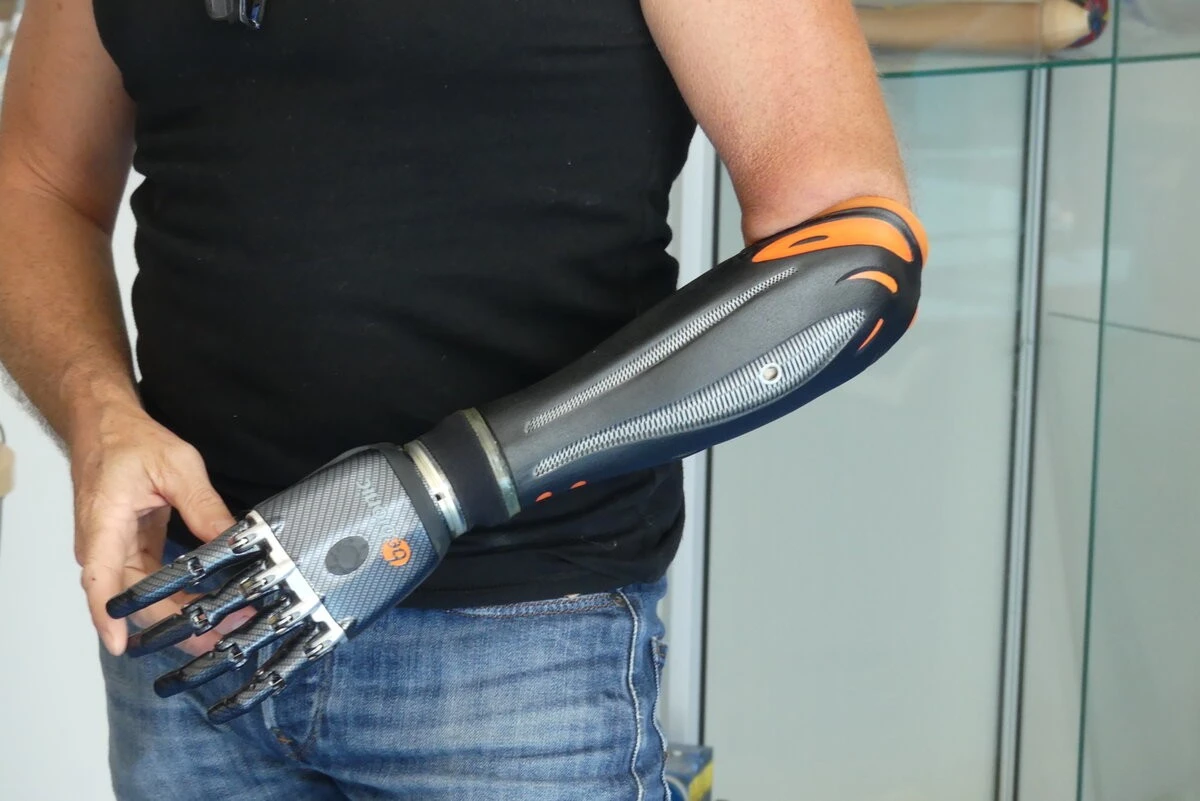
The international company Motorika has gone even further. Her prosthetic hands are not only individually designed, but also allow her to effectively operate a spoon, fork, and even a ballpoint pen. With motor prostheses, a person can operate industrial equipment and perform most everyday tasks. A contactless payment chip or GSM module can be integrated into the prosthesis. That is, you can magically wave your hand over the terminal and your purchases will be paid for. Isn't this the future?
Trevor Prideaux 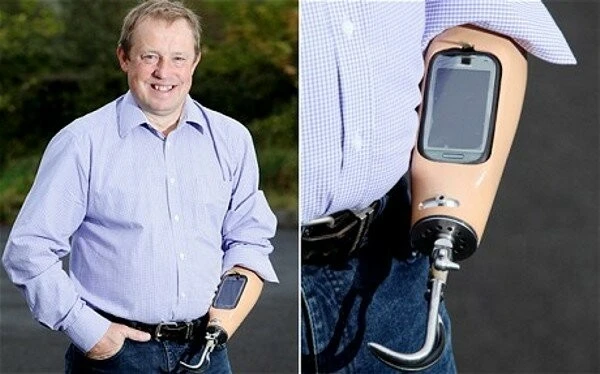
In the modern world, the idea of integrating a smartphone into a prosthesis seems very logical. How can a person live without a smartphone today? This is an irreplaceable item. True, in 2011 people did not think so. But then Trevor Prideaux from the UK became the first person in the world to have a mobile phone docking station built into his prosthetic arm.
Trevor was born without a left forearm and learned to live with it, but it was difficult to use the phone. The guy had to somehow hold the phone on the prosthesis or place it on a flat surface in order to dial a number or write a text. Inconvenient.
Trevor turned to Apple for help, but the company refused to develop a custom prosthesis. Then Nokia came to the rescue. So a docking station was built into the prosthesis. Now a man can easily send messages with one hand, make calls by holding the prosthesis to his ear or using the speakerphone.
Jerry Jalawa 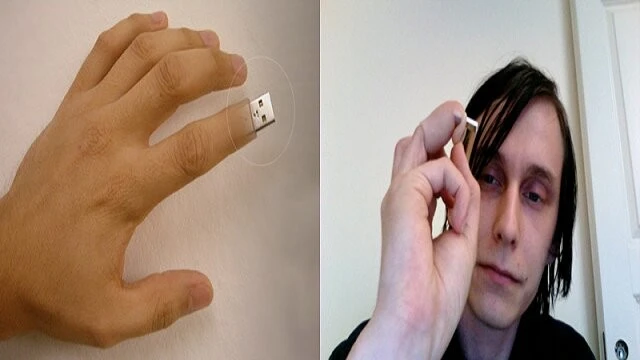
In 2009, programmer Jerry Jalava installed a USB flash drive in the finger in place of the lost phalanx. Sounds like a Halloween costume idea, to be honest. The guy actually lost part of the ring finger on his left hand after he hit a deer on his motorcycle. Jerry quickly learned to type without one finger and even without a prosthesis, but still decided to come up with something unusual. For example, attach a flash drive there. You can use the flash drive by bending the nail on the prosthesis. The guy uses a flash drive to store photos and various computer programs. The artificial finger is detachable, so it can be left connected to the computer.
Nadia Vessey 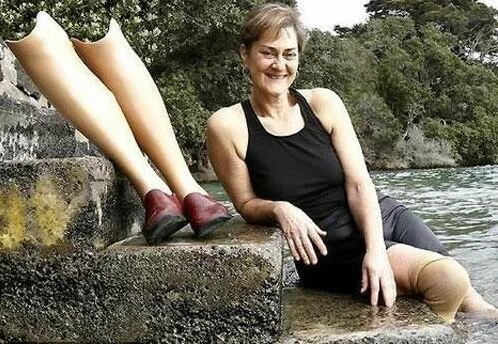
Of all the stories today, the one that strikes us most is that of Nadia Vessey. Due to illness, both legs were amputated, one at age 7, the other at 16. All her life, the girl wore prosthetics, which she removed only before swimming. But one day a little boy approached the girl and asked why she had no legs, and instead of long and sad explanations, Nadya said that she was a mermaid.
The girl herself was inspired by her own words and decided to turn to engineers from a special effects company that received several Oscars for its work on the film “The Lord of the Rings.” The girl wanted to know if they could make her a mermaid tail for swimming. The company happily agreed. After two years and almost 800 hours of work, Nadya received an unusual prosthesis made of neoprene and plastic, covered with a special lycra sock that shimmers with digital scales. It took the girl several years to adapt to the prosthesis and learn to swim more like a dolphin than a human. Now Nadya feels the tail as part of her body. And that's great.
Kelly Knox 
Someone wants to become a mermaid, and someone wants to become an octopus. A project to create alternative prosthetics could make this happen. By the way, this is a project of the same company that gave James Young a prosthetic device with a drone. For model Kelly Knox, the company made a prosthetic in the form of either a tentacle or a vine... Kelly uses it not as a functional tool, but as an accessory for self-expression. 
But this is not an ordinary accessory that just hangs on a person. The tentacle has 26 vertebrae and moves lifelike thanks to sensors in Kelly's boots. Sensors are located under her big toes, they cause the tentacle to move from side to side and flex. By pressing the sensors with varying degrees of force, Kelly can control the speed and direction of movement. As far as we understand, from a practical point of view the prosthesis is not very useful. But this is not a matter of practicality, but of self-expression.
0 comments