Technological features of old houses that are practically useless today (15 photos)
Requirements for a comfortable home have always included the use of the latest amenities and fixtures. Naturally, technologies develop and change. But in old buildings, for example, mansions where owners and their servants once lived, technological signs of the past still remain. 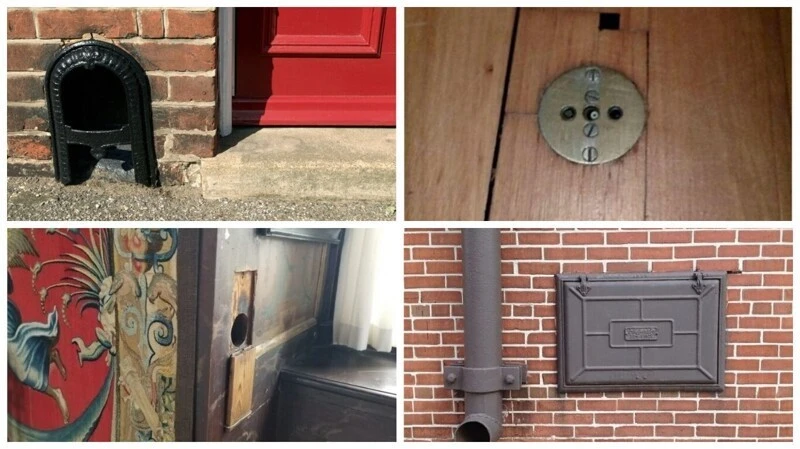
They go back to a time when people did not yet know what mobile phones, central heating or refrigerators were.
Anchor plate (wall anchor) 
Anchor plates, often in a star or "S" shape, can sometimes be found on the exterior of older homes. They were embedded in the brickwork as structural reinforcement to prevent the walls from sagging.
They are most often made of cast iron, although they can be wrought iron or steel. Commonly found in older European cities, they can also be seen in places such as New York, Philadelphia and San Francisco.
Coal Door or Coal Chute 
Before gas heating was introduced in the 1940s, most homes were heated with wood or coal.
Previously, coal was delivered in much the same way as milk - it was delivered by a coal miner on a cart. Coal was not left on the threshold or brought into the hallway, but was poured through a small door on the side of the wall. A chute descended from the door into the basement or coal cellar. In those houses where there was a stove in the basement, coal could be shoveled directly into the stove. In other houses it was transported upstairs in buckets. 
Coal chutes on old buildings can still be seen today, but they are covered with metal covers.
Device for cleaning shoes from dirt 
Such a scraper for cleaning shoes from dirt and snow was usually located at the entrance to the house. In French it is called "décrottoir". Décrotoirs were essential in the 1700s and 1800s, as the lack of paved roads meant that a visitor could come to your home with boots covered not only in the usual mud, but also in horse manure.
Door or cabinet for milk delivery 
A special “milk” door was installed in the walls of some houses so that the milkman could leave new bottles there and pick up empty containers. This is something like a cabinet built into the wall, one door of which opens from the outside, the other from the inside.
Cellar for storing supplies 
A cellar can simply be a small part of a basement or pantry used to store fresh fruit, jams, preserves and vegetables. However, some homeowners actually built a second basement that could be used solely for storing perishable food during the colder months. Depending on the weather, humidity and crop condition, vegetables and fruits can be stored in the cellar for weeks or even months.
Transom with windows (above doors) 
At a time when there was no electricity, the entrances were very dark and gloomy. That's why they came up with such a thing as a transom. This is the upper part of the front door, which can be glazed and will allow light to pass through. And if you make it movable, then the windows can be opened for ventilation.
Butler button hidden in the floor 
Have you ever seen such strange buttons right on the floor? It turns out they have a name and a purpose. They are called "butler buttons" and were popular in the late 1900s as a way to summon service personnel. The buttons were placed in the center of the room, and then the wire was usually routed (under the rug) to the table or nightstand where the calling device was located.
Sleeping verandas 
The sleeping verandas were half inside the house and half outside. They were not necessarily located at the front door or at ground level, despite the name "veranda". These were balconies or decks, sometimes enclosed or surrounded by windows, designed for a specific purpose. These rooms were cooler than the others, and were often used as a place where children slept in the summer. Or those who needed more fresh air slept there. For example, doctors recommended that tuberculosis patients sleep in such rooms all year round.
Basement toilets or "Pittsburgh potties" 
Separate basement toilets were nicknamed "Pittsburgh potties" in the United States because such toilets were most often found in Pittsburgh, Pennsylvania. It is a historically industrial city where metallurgists and miners lived. And after a long day of work, they would go to their basements to clean up - before entering the main part of the house.
However, this does not explain why some houses have just a lone toilet in the basement and no other amenities. Some explain this by saying that before World War II, this solution helped to avoid problems with wastewater.
Dumbwaiter 
The dumbwaiter was a mini freight elevator designed for food. In any home where the kitchen and dining room were on different floors, dishes could be transported using a dumbwaiter rather than up the stairs. It was faster (to keep food warm) and avoided spills and collisions.
In 20th-century London they were especially popular in the homes of wealthy people, and maids also used such lifts to move linen from one room to another. However, elevators were also a popular hiding place for children, and various fatal accidents and injuries were one of the reasons why these devices fell out of fashion.
Today they are installed in commercial buildings such as hospitals, schools, restaurants and nursing homes.
Servant bells 
This device for calling servants was usually located just below the kitchen ceiling. The bells were connected to handles in different rooms, and a label under each bell told the servants which room they were called to. Manually operated bells were eventually replaced by button-operated buzzers, and these were gradually replaced by intercoms.
Voice tubes for communication, 17th century 
Sometimes, instead of (or in addition to) servant bells, speaking tubes were used to connect different rooms in the house. They were the predecessors of the intercom. These were literally tubes with mouthpieces on the ends that went through walls and connected different rooms. Sometimes the mouthpiece of the speaking tube was placed behind the front door so that visitors and couriers could announce themselves.
Push button light switch 
A push-button light switch is one that has two buttons: one to open the contacts and the other to close them. When one button is pressed, another pops up. On switch usually located at the top, although it also often had a white insert for additional identification. They were later replaced by modern switches, but push-button switches can still be purchased today if you want to give your home a vintage look.