Tiger python and interesting facts about it (11 photos)
We continue to get acquainted with the heroes of the Soviet cartoon "Mowgli", today we have the python Kaa, the oldest and wisest creature in the world. (As usual, for those who are too lazy to read, the video is at the end) 
First, a little biology:
The tiger python (lat. Python molurus) is a large non-venomous snake from the genus of true pythons. One of the most famous species of the genus.
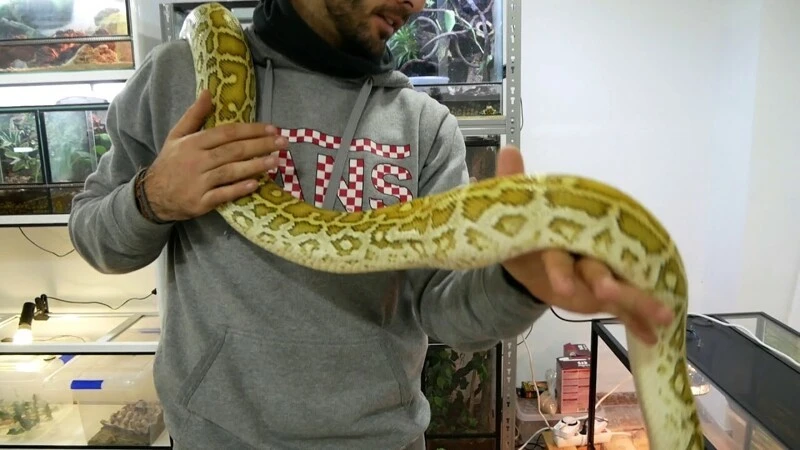
A large and massive snake. Body length can vary from 1.5 to 4 m or more, depending on gender (females are usually larger than males) and lifestyle. The largest recorded length for this species is 4.6 m and weight is 52 kg. Coloring is variable. Typically, brown and red-brown spots are located on a light yellow-brown background, forming a complex carpet pattern. In young individuals this pattern is especially pronounced. A dark stripe runs through the eye, starting from the nostrils and extending into spots on the neck. Another stripe goes from the eye down and runs along the upper labial scutes. 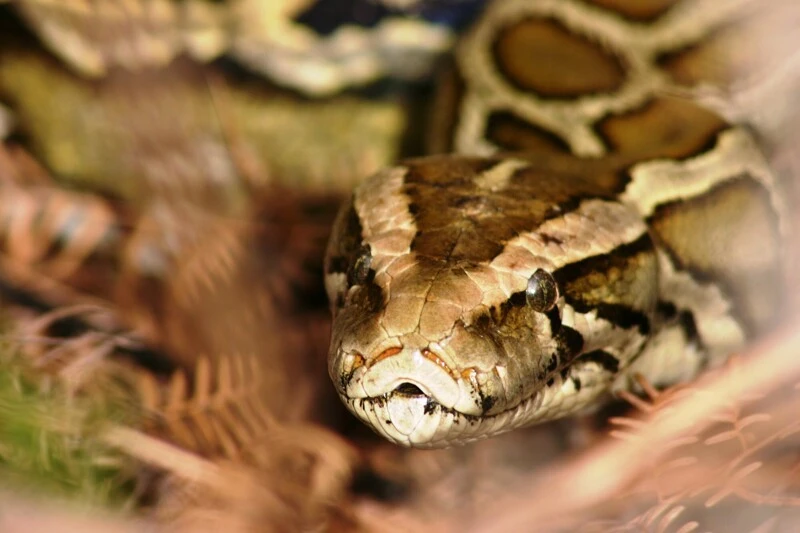
There is a dark arrow-shaped spot on the top of the head. The four upper labial scutes have heat-sensitive pits, which means that the snake can find prey even at night, focusing on the difference in temperature between the environment and the victim’s body. Pythons have a vertical pupil, and the head is clearly differentiated from the neck. On the sides of the anal shield there are noticeable processes - rudiments of the hind limbs. The powerful, prehensile tail makes up about 12% of the total length in females and up to 14% in males. 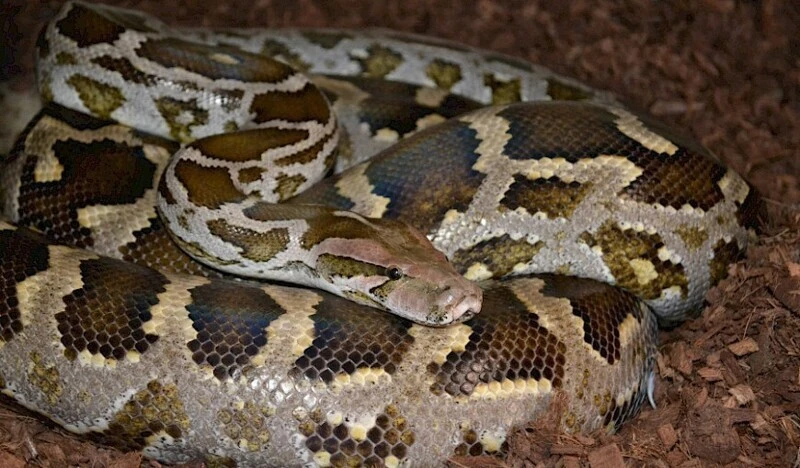
Molting is not confined to a specific season. In growing individuals, molting occurs monthly, and adult snakes change their skin every 3-6 months and lasts about two weeks. Before molting, the tiger python's color fades and its eyes become whitish and cloudy. The old skin can peel off from the python either as a whole stocking or in separate pieces. During molting, pythons do not feed.
The tiger python (Python molurus) has two subspecies. Light or Indian (Python molurus molurus) and Ceylon (Python molurus pimbura).
Pythons feed mainly on mammals and birds: small ungulates, rodents, monkeys, pheasants, ducks and other animals. There have been cases of large pythons attacking leopards and jackals. 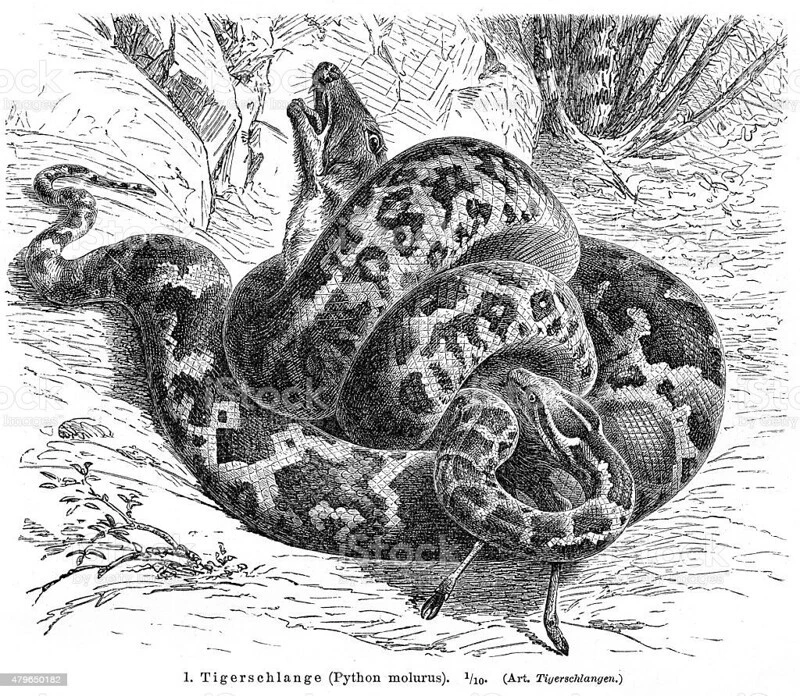
The species is widespread in South and Southeast Asia within Pakistan, India, Bangladesh, Burma, southern China, Indochina, Malaysia and Indonesia.
It lives in a wide variety of biotopes: tropical and sparse forests, swamps, bushes, fields and rocky foothills. It uses burrows of various animals, hollow tree trunks, and reed thickets as shelters. It rises into the mountains to an altitude of 1500-2000 m above sea level. It usually stays along the banks of water bodies, swims well, and often stays in the water for a long time. Good at climbing trees.
Hunts at night and attacks prey from ambush. Tiger pythons are fairly sedentary and not very active snakes.
Pythons kill their prey by squeezing them in the rings of their body. This compresses the victim's respiratory center, but does not fracture the ribs. Next, the reptile swallows the prey whole, starting from the head. 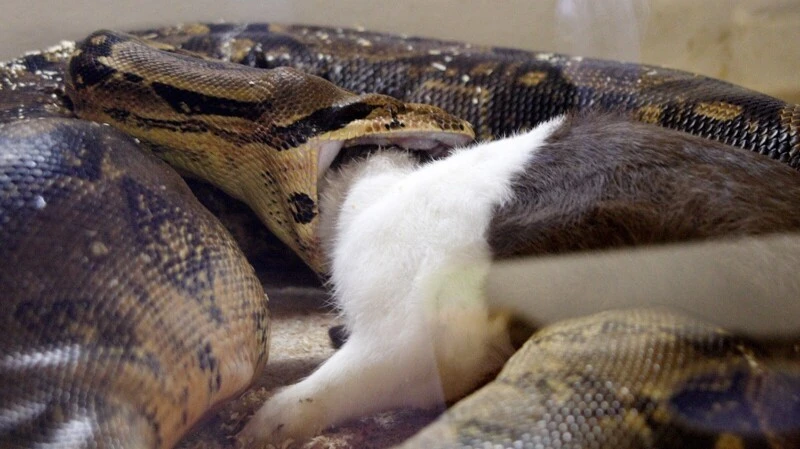
The breeding season, like all pythons, begins in late autumn - early winter. Eggs are laid 80-90 days after mating. The clutch sometimes includes up to 100 (usually up to 60) very large (6x12 cm) white leathery eggs. The incubation period lasts about 2 months. The length of newborn snakes is 50-75cm. Young snakes begin to feed after the first moult. Females usually reach sexual maturity at 3.5 years, males somewhat earlier. 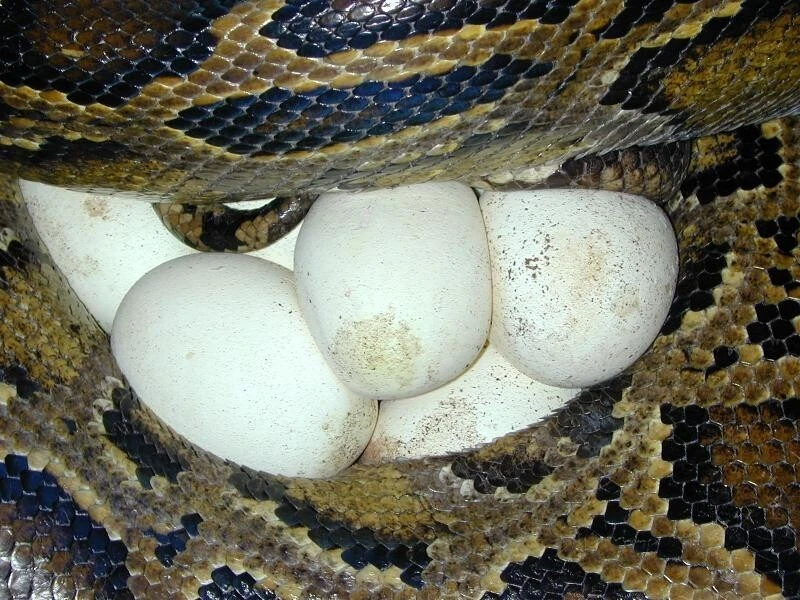
In addition to people, the tiger python has many enemies, especially at a young age. These include, for example, king cobras, Indian mongooses, big cats such as tigers and leopards, bears, various owls and some birds of prey such as the black kite.
The maximum lifespan of a tiger python in captivity is 25 years.
Interesting Facts:
- Rudyard Kipling in the collection of stories “The Jungle Book”, which tells about the adventures of Mowgli raised by wolves, described the tiger python Kaa as one of the oldest and wisest creatures in the world.
- In Southeast Asia, tiger python meat is used for food, and the leather is used to make shoes and clothing. They are often kept by the local population in homes as pets. This is connected with existing superstitions, but also has a functional meaning, since pythons actively destroy mice and rats in homes.
- The tiger python is one of the most popular snakes kept in captivity. Many pythons are caught for zoos and circuses. This beautiful and calm snake is often kept in terrariums of exotic animal lovers. Tiger pythons breed well in captivity.
- Tiger pythons are not difficult to keep. Necessary conditions are a spacious terrarium, a shallow large pool with warm water and thick branches for climbing. Since these animals are inhabitants of the tropics, the temperature and humidity should be high (26-32°C and 70-80%, respectively). These snakes are usually well tamed and are easy to care for. An adult python only needs one rabbit every two weeks.
- Pythons are able to digest their food for a long time, the duration depends on temperature conditions - the warmer it is, the faster this happens. At 18°C, a python digests a rabbit in two weeks, and at 28°C - in just 3-5 days. During the breeding season, pythons do not eat: the hunger strike for males lasts up to five months, for females - up to seven. 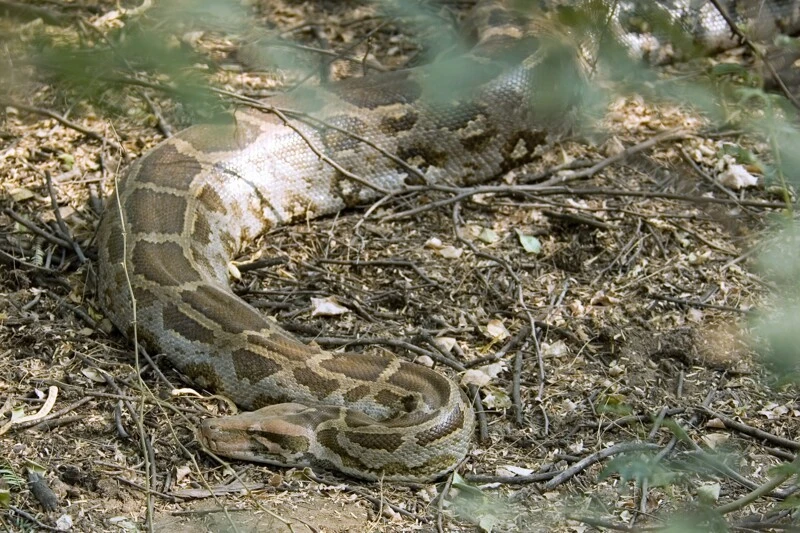
- Until recently, the dark tiger python Python bivittatus was also classified as Python molurus. Currently, the dark tiger python has been assigned the status of an independent species with two subspecies.
- Over the past 20 years, these reptiles have been bred on specialized farms in the countries of Southeast Asia. Their meat from Vietnam is already supplied to the European Union.
- In northern Pakistan, India and Burma, animals hibernate from December to February. They gather in groups and hibernate together under rocks, tree roots, or in underground shelters under a thick layer of fallen leaves.
- Under unfavorable conditions, the tiger python can migrate to other territories. In one day, adult individuals are able to cover distances of up to 2.3 km on land.
- The female tiger python knows how to regulate the temperature of the clutch; on cool days, she trembles all over her body, increasing the temperature by 7°C. This helps her maintain an optimal incubation regime of about 30.5°C.
- The largest clutch of a tiger python was recorded in northern India and consisted of 107 eggs.
- The Indian python is classified as critically endangered on the IUCN Red List due to a likely population decline of approximately 30% over the decade 2010–2020, caused by habitat loss, overexploitation and lack of conservation measures.
- Lateral placement of the eyes provides a field of view of 135°.
- Animals sometimes climb to considerable heights, for example, in southern India, a python with a total length of 1.5 meters was seen in the top of a tree at a height of 15 meters while eating a flying fox. 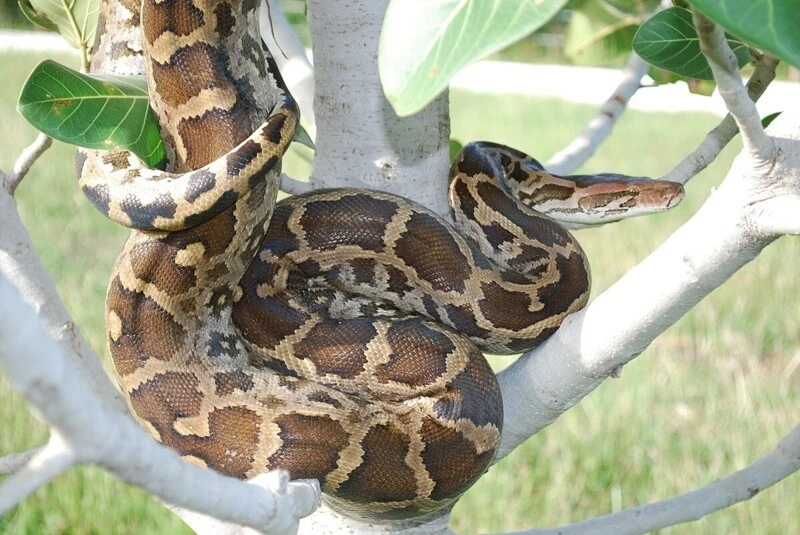
- There are several colored forms: - “Albino” - an albino form with a white or yellowish main background and spots of lemon yellow or orange, red eyes. "Green" is a recessive color mutation; the color is olive-yellow or greenish-brown with a dark longitudinal stripe along the spine. 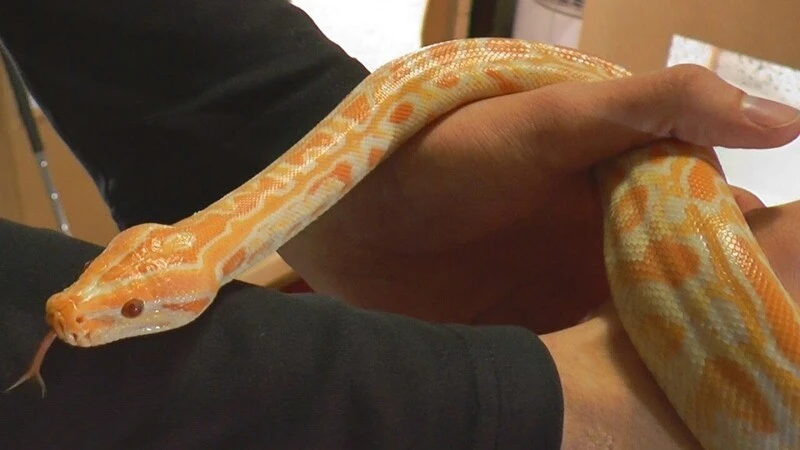
- In Keoladeo National Park, where there are no hollow trees, rock crevices or other shelters, the tiger python lives in the burrows of the Indian porcupine. Notably, pythons share most of their burrows with porcupines, although these mammals are commonly preyed on by pythons. A possible explanation for the tolerant coexistence may be the narrowness of the burrows, which prevents the python from being caught, strangled and devoured.
- In Everglades National Park, Florida, tiger pythons were illegally released, and since 1979 they have been able to settle there. There has been a significant increase in the population since 2001; in 2007, the number of snakes was already estimated at 30,500 individuals. Snakes are considered a threat to native animals such as bobcats, marsupials, Carolina grebes, white-tailed deer and coyotes. Small and medium-sized Mississippi alligators are also hunted. Thus, a two-meter alligator was found inside a dead snake 3.86 meters long. On the other hand, smaller pythons are also eaten by alligators. 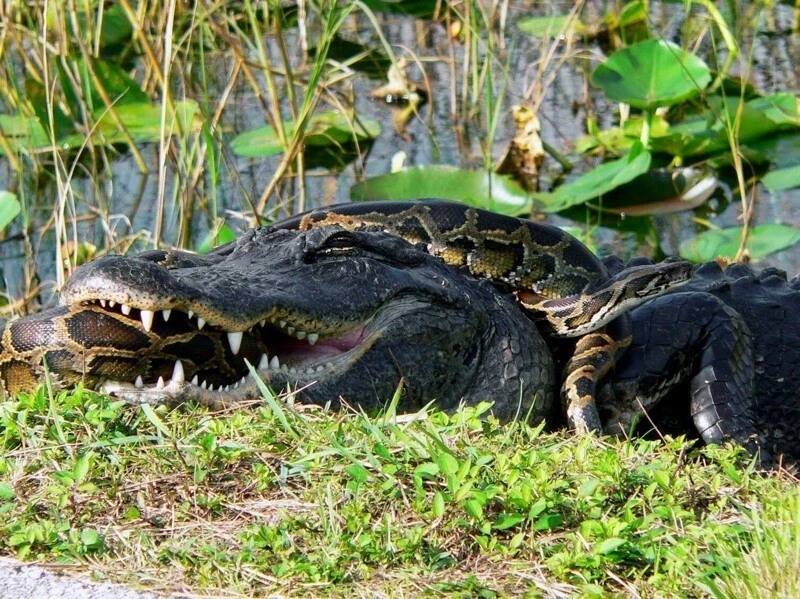
- Studies of tiger pythons have shown that when digesting a large food animal, a snake's heart muscle can increase by 40%. The maximum increase in heart cells (hypertrophy) is achieved after 48 hours due to the conversion of proteins into muscle fibrils. This effect promotes an energetically more favorable increase in cardiac output, which speeds up digestion. In addition, the entire digestive system adapts to digestive conditions. This is how the intestinal mucosa increases up to three times two days after feeding. After about a week, it shrinks to its normal size. The entire digestion process requires up to 35% of the energy absorbed from prey.