Greek mythology is full of strange and wonderful creatures. While the most famous were those sent to thwart the ancient Greek heroes, Greek mythology was also full of useful creatures. Perhaps the most famous of all was the centaur Chiron, half man and half horse. Chiron was a wise being responsible for teaching several important Greek heroes. 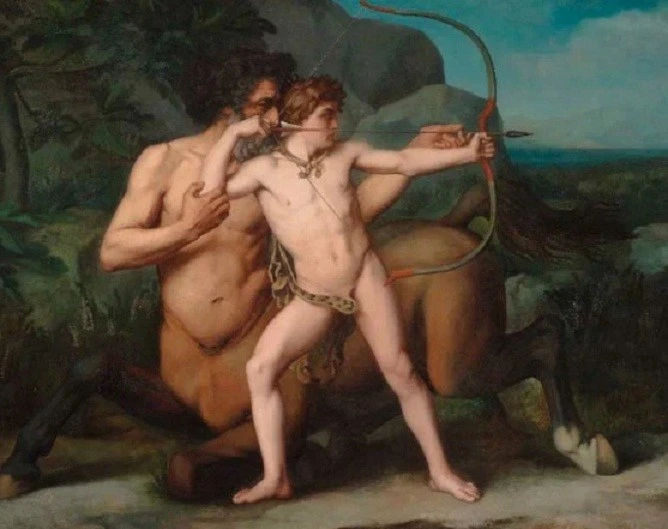
Who was Chiron?
Chiron was considered the wisest of all centaurs. Centaurs, like satyrs, generally had a bad reputation. They were considered wild, overly lustful, drunkards who became violent when intoxicated. In general, they were considered to lack culture. Chiron was the opposite. He was smart, civilized and kind. Perhaps this was partly due to his origins; he was not directly related to the other centaurs.
Chiron was an expert in medicine and is credited with the discovery of botany and medicine. Chiron continued to teach the young Greek heroes all the skills his adoptive father Apollo had taught him.
Chiron's family
Most centaurs were born from Ixion, the king of an ancient Greek tribe, and Nephele, a cloud nymph. Chiron, on the other hand, was fathered by Kronos, the father of Zeus, and the nymph Philyra. According to ancient myth, Kronos was having sex with Philyra when he was caught by his wife Rhea. This prompted him to transform into a horse mid-coitus in order to escape. His transformation at the moment of culmination led to the birth of Chiron.
Chiron married a nymph named Chariklo. They had three daughters, Hippa, Engeida and Okiroya, and one son, Carystos. In addition to these children, Chiron and his wife would raise several mortals who would grow into heroes.
Chiron's childhood
Philyra was ashamed of how her child was conceived and disgusted by Chiron's bestial appearance. Shortly after his birth, Chiron was abandoned by his mother and left to die. Fortunately for him, he was found by Apollo, who decided to take the orphan in with him. Apollo taught the young centaur the art of playing the lyre, archery, medicine and prophecy.
Apollo then introduced Chiron to his sister Artemis, the goddess of the hunt. Artemis taught him how to use a bow and hunt with it. The fact that Chiron grew up to be so level-headed, peaceful, kind and intelligent is due to the way he was raised.
Chiron's unique character meant that he soon became the first among the centaurs. In addition to his role as leader of the centaurs, he also became a revered teacher and mentor to the people.
Chiron and Peleus
In Greek mythology, Peleus was a great hero and king of Phthia. He was married to Thetis, and their child Achilles became the most famous of the Greek heroes. Peleus and Chiron were closely related, as Chiron was his grandfather. Peleus was the son of Chiron's daughter Endeis and Aeacus, king of Aegina.
One day Peleus stopped in the ancient city of Iolcus. While there, Astidamia, the wife of King Acastus, tried to seduce him. Being a noble man and no fool, Peleus refused her. This turned out to be a mistake.
Rejected, Astydamia approached her husband and told him that Peleus had tried to rape her. The king wanted Peleus dead, but he had a problem. Killing a guest was one of the worst crimes in Ancient Greece; this would incur the wrath of the Furies. Looking for a loophole, Acast began looking for a way to blame someone else for the death of his guest.
Acastus decided to take Peleus hunting on Mount Pelion, which was a common activity for the host and his guest. On the first night, while Peleus was sleeping, Acastus stole Peleus' sword and hid it. He then slipped away and went home. He planned that the wild centaurs who lived on the mountain would find Peleus and kill him.
Of course, if you're planning on having the centaurs kill a person, that person probably shouldn't be the grandson of the centaur leader. It was Chiron who found Peleus. Chiron re-educated the young man and invited him to his home.
Peleus later returned to Iolcus and plundered it. He killed the king and dismembered Astydamia, leading his army between her severed limbs. The kingdom fell and was eventually claimed by Thessalus, the son of the hero Jason.
Chiron was also responsible for the marriage of Peleus and his wife Thetis. Peleus was in love with Thetis, a Nereid and minor sea goddess. The problem was that Thetis had no interest in marrying a mere mortal, no matter how great his reputation. As a Nereid, Thetis could change shape to avoid a man's advances.
Peleus went to the wisest being he knew, Chiron. Chiron told Peleus how he could capture and bind Thetis so that she would not change and escape. Peleus managed to capture Thetis, and she eventually relented, agreeing to marry him.
Chiron attended their wedding and his gift was a special spear. The shaft was made of ash and polished by Athena herself. The metal tip was forged by Hephaestus, the armorer of the gods. This spear would later be given to the couple's son, the mighty Achilles.
Chiron Teacher
Chiron's greatest influence on Greek mythology was probably the number of young heroes who gravitated to him for lessons. Chiron was responsible for raising and training many Greek heroes, who used these skills during their adventures.
Achilles
It is perhaps not surprising that Achilles was eventually taught by Chiron, given Peleus and Chiron's relationship. There are two versions of how Chiron came to raise his great-grandson Achilles. In one, it was Thetis who led Achilles to the centaur. She was caught trying to make Achilles immortal and was forced to flee the royal palace. On another occasion, it was Peleus who took his son to the centaur.
Achilles was raised by Chiron and his wife. Chiron taught him everything he knew and also fed him the entrails of lions, bears and boars so that he would grow big and strong. In some versions, Chiron also renamed his young charge. It was said that the young hero's name was originally Ligiron, but Chiron changed it to Achilles.
Aristaeus
Aristaeus was a minor god born of Apollo and Cyrene, the huntress. Apollo took Aristaeus to his adopted son Chiron. Chiron raised and trained the young god Aristaeus, who later became the village god, the god of arts such as beekeeping and cheese making.
Actaeon
Actaeon was the son of Aristaeus and one of the centaur's most tragic students. Chiron taught young Actaeon to be a skilled hunter. Later, Actaeon was hunting in the forest when he came across Artemis bathing. Angered that a mortal saw her virgin body naked, Artemis turned the hunter into a stag.
Unfortunately, Actaeon's hunting dogs did not recognize their master in his new appearance and devoured him. They then returned home to Chiron's dwelling to find their master. The dogs were so distraught over the loss of their master that Chiron created his image to calm the suffering dogs.
Asclepius
Asclepius was the Greek god of doctors. At this point, it's easy to guess where he got his skills. Asclepius was the son of Apollo and a mortal named Coronis. Foolishly, Coronis cheated on Apollo with a mortal, Ischius. Ischias was then killed by Apollo, and Coronis by Artemis.
Coronis was placed on the funeral pyre to be burned, but before the flames could engulf her, Apollo rescued Asclepius from her womb. He then took the baby to Chiron to be raised. Chiron taught the boy the art of medicine and healing.
Asclepius became the greatest of all the Greeks, and it was said that he eventually surpassed his teacher. This was his undoing. Asclepius became such a skilled surgeon that it was rumored that he could even resurrect the dead. Zeus could not stand it and killed him.
Death of Chiron
As the son of the Titan Kronos, Chiron could not die. And yet this happened, thanks to Hercules, the son of Zeus.
The fourth labor of Hercules was to kill the Erymanthian boar. During these labors, he visited the cave of another wise centaur, Pholus. While Pholus, Hercules and Chiron were having lunch, Hercules asked for wine to go with the meal.
Pholus did not actually drink, and the only wine he had in the cave was the sacred wine left by the god Dionysus, who ordered him not to open it until the right time came. Hercules refused to take no for an answer and forced the centaur to bring the wine. Then Hercules snatched the wine from the centaur and forcibly opened the jug.
The smell of the sacred wine intoxicated the nearby centaurs waiting outside. They went berserk and attacked the cave. Hercules was forced to take up his bow and repel the attack. Arrows rained down inside and outside the cave. In the confusion, Chiron was struck in the thigh by one of Hercules' arrows.
A simple arrow wound shouldn't have been a problem for an immortal like Chiron, but unfortunately those arrows were drenched in Hydra's blood. The Hydra's blood was poisonous enough to kill any mortal instantly. Being immortal, Chiron suffered from pain. Even his powerful healing powers could not lessen the agony.
Chiron went to Zeus and asked him to take away his immortality so that he could die and avoid pain. Zeus, who respected him, agreed and allowed Chiron to die. He then placed it among the stars as the constellation Centaurus.
In a slightly different version, Hercules approached his father Zeus and asked him to let Chiron die. In this version, Hercules made a deal with his father in which Chiron died and in return Prometheus, who was tortured by Zeus, was freed.
Since Zeus loved Chiron and hated Prometheus, it is unclear what Zeus gained from this deal. Perhaps Zeus allowed Hercules to release Prometheus in order to assuage his son's guilt for essentially killing his beloved Chiron.
Conclusion
There are very few characters as noble as Chiron in Greek mythology. Chiron was in a unique position: he was loved by both gods and mortals. Unlike most Greek gods and heroes, Chiron never had any particular weaknesses. He was a kind, smart, wise creature who only wanted to help others.
Chiron's noble nature was reflected in his death. Unlike many of his students, Chiron died a noble death, choosing to die with dignity rather than live in pain. Even Zeus, perhaps the most temperamental of the gods, respected him enough to grant his last wish.
The portrayal of Chiron as a wise and noble teacher reflects the great respect Greek society had for teachers and those who shared knowledge responsibly. It is significant that Chiron was killed not through his own fault, but through the ignorance of the young and stubborn Hercules. Even in death, Chiron was able to teach one last lesson.
0 comments