5 answers to important questions about moles on our body (3 photos)
What types of moles are there? Are those who have a lot of them really at risk? What moles are dangerous and can they be removed? The oncologist professor answered the most common questions about nevi. 
A mole (nevus) is a pigmented spot or nodule consisting of clusters of melanocytes (cells containing the pigment melanin). Everyone has moles, or, as they are correctly called, nevi: some have more, some have less. They can be smooth or lumpy, of different shapes and colors. Moles, like constellations, can be scattered on the body in groups of several or occur singly. They change, appear and disappear with age. In some cases, moles can transform into melanoma, a non-epithelial malignant tumor.
The most dangerous moles are large, convex, dark in color?
The size, prominence, and intensity of pigmentation of a mole do not always indicate the risk of developing melanoma. Small flat moles with uneven, blurry borders or uneven color (for example, one side is light and the other is almost black) can also pose a danger. Therefore, if large nevi or any changes in the mole are detected, it is better to show it to a dermatologist. Melanoma can occur in both dark and light moles, so both pigmented and non-pigmented formations need to be examined by a dermatologist.
Konstantin Titov: “There are dangerous moles, precursors of melanoma: giant congenital nevi, dysplastic nevi or borderline nevi. People with them should periodically contact a dermatologist, undergo dermatoscopy, and study using a photofinder. This means that the doctor takes photographs of the entire body and creates a map of the moles, or a “skin passport.” Once every six months or year, a person must undergo this examination again, if any nevi increase, grow or change. This approach will allow us to detect the problem in time and conduct a more detailed study of it.”
Can a large number of moles on the body lead to skin cancer?
There is no consensus on how many moles should be considered safe. Until recently, the threshold at which the likelihood of developing melanoma arose was considered to be 50 or more moles. Today we are talking about 100 or more. These are so-called moles without counting, and a person with so many nevi is at risk. However, there are few such people.
In 75-80% of cases, melanoma occurs spontaneously. So a large number of nevi in itself is not considered a manifestation of melanoma and does not indicate a mandatory predisposition of the skin to cancer. But people who have many moles should be most careful about them.
Konstantin Titov: “Large serious studies have shown that melanoma in 75-80% does not occur against the background of moles. And in 20-25% it can transform against the background of certain nevi. That is, the connection with moles is not so direct and absolute. 80% actually occurs spontaneously, on unchanged skin, but in an area that was previously burned. And 20% of melanomas transform against the background of so-called melanoma-dangerous nevi.” 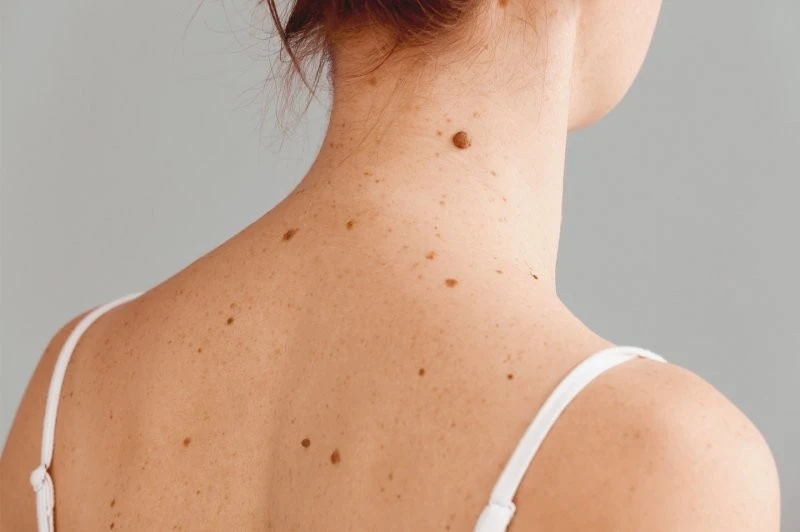
Is it possible to remove moles?
You cannot remove moles on your own, nor can you seek advice from a beauty salon. Which moles can be removed and in what way can only be determined by a dermatologist. Why? Any unprofessional removal of nevi can lead to complications. Today there are several removal methods. For some moles, instant cutting using high-frequency current is quite suitable, while for others you will need a scalpel. In special cases, specialists use laser or liquid nitrogen.
Are new moles on the body a warning sign?
The appearance of moles on the body is a natural process for many people. For some, they arise spontaneously in a short time, for others - throughout life. There are also congenital moles that appear in the first months after birth.
As a rule, moles themselves are quite safe. Therefore, if they do not cause discomfort, their color, size or shape do not change, then you should not touch them.
Konstantin Titov: “90% of the world’s population have moles. For most, they manifest themselves during puberty, in childhood, and throughout life, but this is not a reason to immediately run to the doctor. Only if you notice that one of them begins to grow more actively, changes color, shape, edges and there are changes that are different from others, you should see a doctor.”
How to identify dangerous moles?
There is a special ABCDE method. It was designed to allow you to self-examine your body to look for strange moles or growths. The Latin letters in the abbreviation indicate a step-by-step examination of moles according to five parameters:
Checking moles using the ABCDE method:
A (asymmetry) - asymmetry of the sides of the mole (one half is not symmetrical to the other);
B (border irregularity) - uneven edge of a mole;
C (color) - unequal color on different parts of the mole;
D (diameter) – the diameter of the mole is more than 6 mm (use a ruler for inspection);
E (elevation and/or evolution) - variability of the mole (has the mole changed color and/or size recently). 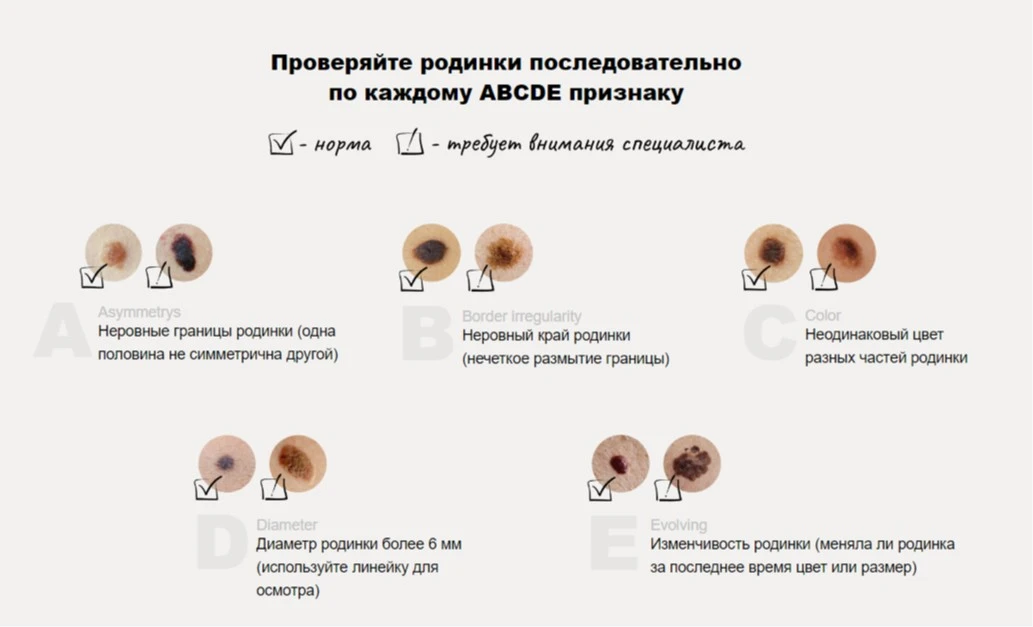
The presence of two or more parameters from this list should alert you, and in this case it is better to consult a doctor. Normal is when the color, size and shape of the mole do not change.
Unlike internal organs, the skin is always visible; it is the largest organ of our body. Therefore, any changes can be noticed independently. Those who are at risk (have countless moles) are recommended to undergo a medical examination regularly: once every six months to a year.