When does a knife begin to be considered a bladed weapon (7 photos)
In everything related to weapons or items directly or indirectly related to them, the awareness of the population of our country is at an extremely low level.
There is no understanding of what is and is not allowed to purchase, possess, carry, or use for hunting or self-defense. 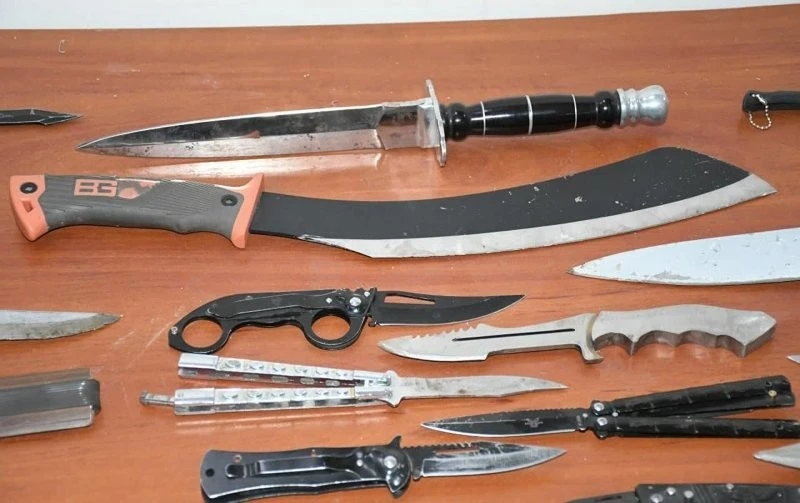
Often this leads to the fact that people simply do not use the opportunities that the state provides them to pursue their hobbies or to ensure their safety.
Often the opposite situation arises, when a person acquires and uses certain items, and later it turns out that these actions are a violation of the legislation of the Russian Federation. Which, at best, leads to a fine, and at worst, to criminal liability.
One of these “gray areas” is information about edged weapons (KW). It often includes knives used in everyday life with a folding or fixed blade, which in fact are not any kind of “cold weapon”.
It is also worth distinguishing between the concepts of “melee weapon” and “object used as a melee weapon.” In the second case, the definition is applied as a context to the description of the commission of a crime, then the object used as a bladed weapon can be an ordinary stone. 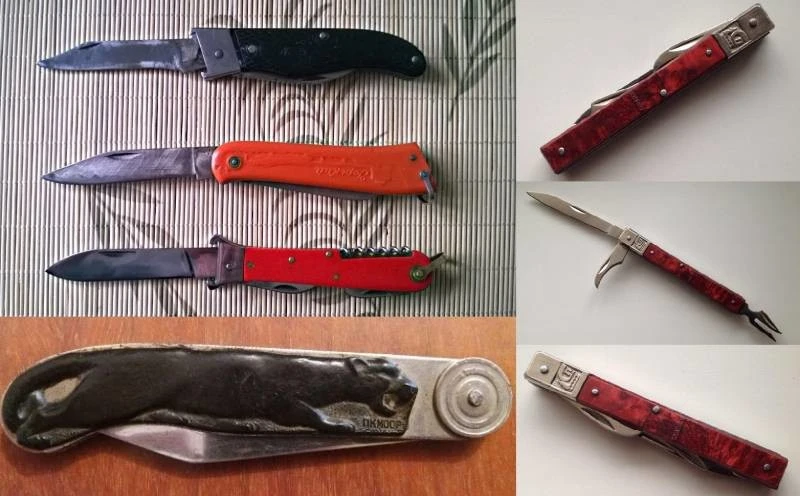
In the Soviet Union, the attitude towards knives was extremely negative.
In fact, most of the knives sold were either extremely poor in their characteristics or belonged to edged weapons, which could only be purchased with a hunting license. Of course, partly the primitiveness of the knives sold was due to the general primitiveness of the civilian product market in the USSR. But legal restrictions on their use also played a significant role.
Illegal acquisition and carrying of bladed weapons in the USSR was punishable by criminal liability. Any use of even a non-cold knife as a weapon of self-defense would most likely also lead to the conviction of the defender.
Of course, the criminal world ignored all these prohibitions - if someone is going to commit a robbery or murder, then the legality of carrying a crime weapon will not worry him much.
However, criminals often used (and use) household items for these purposes. For example, an awl or a screwdriver. So strict restrictions on the carrying of knives did not bring any benefits to potential victims.
The lack of high-quality knives on sale led to a large number of cases of their handicraft production. Moreover, for making a knife and attempting to sell it, one could get another sentence. Sometimes we came across quite interesting specimens. However, rarely do any of them compare with modern high-quality factory products. 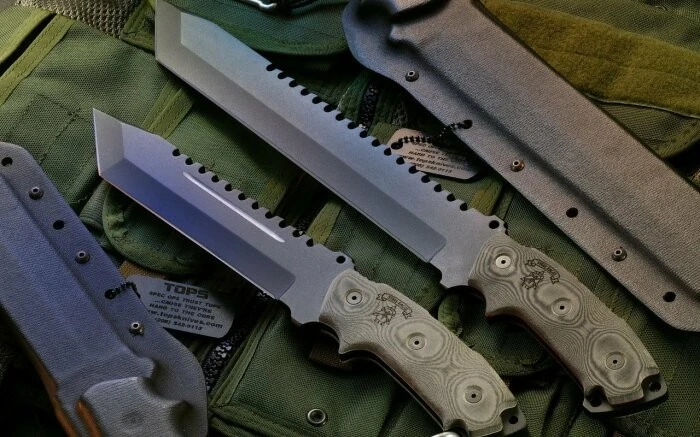
Not every knife is a bladed weapon, but almost all bladed weapons are a “knife” in one way or another. It is extremely important to be able to distinguish a bladed weapon from an object that is not one. But doing this is not as easy as it might seem.
Sometimes, in order to determine whether a knife belongs to a particular class, you will have to familiarize yourself with a whole trail of documents.
Before approaching knives and numerous State standards, you should definitely familiarize yourself with the Federal Law of December 13, 1996 N 150-FZ (as amended on July 6, 2016) “On Weapons.” This document contains a direct ban on the circulation of switchblades and butterfly knives with a blade length exceeding 90 mm. The same document introduces the concept of “civilian edged weapons.” Next, a novice knife lover will have to get acquainted with two categories of documents.
Category one: permitted and prohibited knives. Various information about which knives are directly prohibited from carrying and handling, and which are still allowed, can be found in GOST 51015-97 “Household and special knives” and GOST 52737-2007 “Hunting cleavers, tourist machetes.” You will also have to familiarize yourself with two more documents - these are GOST 51644-2000 “Cutting and skinning knives” and GOST 51501-99 “Tourist and special sports knives”.
Second category: weapons and tools. Specific information about what is already a weapon and what is still a tool can be found in two documents. The first is GOST 51548-2000 “Survival knives”. The second is GOST 51500-99 “Hunting knives and daggers”. 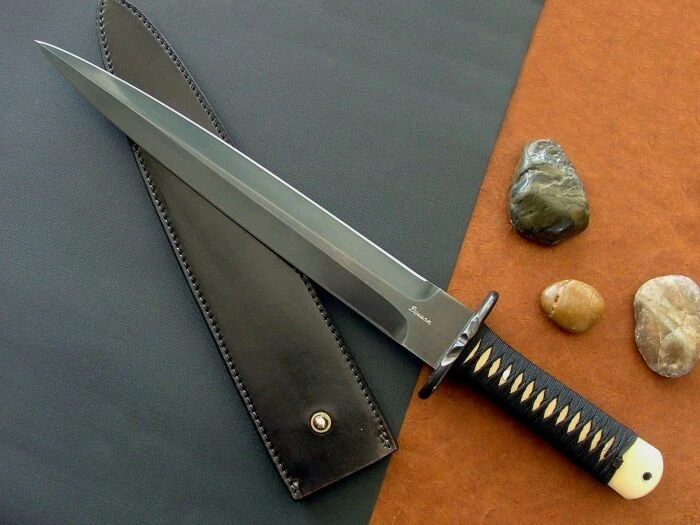
Today, there are 5 mandatory criteria, subject to which a knife is considered a bladed weapon. If a knife, for example, meets only 4 out of 5 criteria, then it will no longer be classified as a weapon. In addition, the law contains 22 provisions that remove the knife from the category of bladed weapons. It's time to get acquainted with each of the two sets of criteria.
Five main features “FOR”: blade 90 mm or more, spine thickness 2.5-6 mm, steel hardness from 25 HRC, presence of recesses on the handle and limit stops, extended cutting edge.
Twenty-two signs “AGAINST”: a blade shorter than 90 mm, one-and-a-half sharpening of the spine by 2/3, a developed limiter with a blade length of 150 mm and a spine thickness of up to 2.5 mm, a folding knife with a blade length of up to 150 mm shorter than the handle when folded, automatic or frame folding knife with a blade up to 90 mm, a special sports knife with a blade up to 90 mm and without a blade tip, the tip is 5 mm higher than the spine, the maximum deflection of the spine exceeds 5 mm with a blade length of up to 180 mm or exceeds 10 mm with a blade length of more than 180 mm, on the butt of the knife there is a hook for ripping skins with a length of no more than 1/3 of the tip. 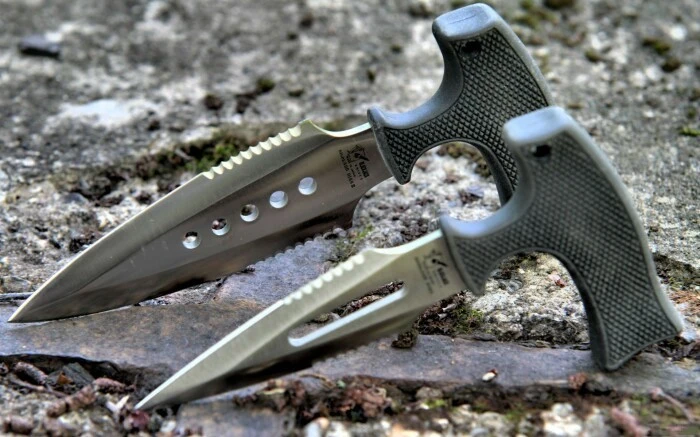
In addition to the above, a knife is not considered a weapon if: the deflection of the butt exceeds 15 mm when the tool is shaped like a rocker, the handle is shorter than 70 mm, there is a barrel-shaped handle with a difference in maximum diameter in the pommel area of up to 8 mm, there is a single stop or a recess for a finger of less than 5 mm, instead of an edge there is a rounded or chisel with an area of up to 3 mm, the knife has several notches or stops with a value of up to 4 mm, the blade and spine of the knife converge at an angle of 70 degrees, the thickness of the knife exceeds 6 mm, there is no cutting edge, the hardness of the blade is below 42 HRC , there is a notch on the blade, the blade is made of materials with insufficient strength for a weapon, the knife has a weak blade seal. 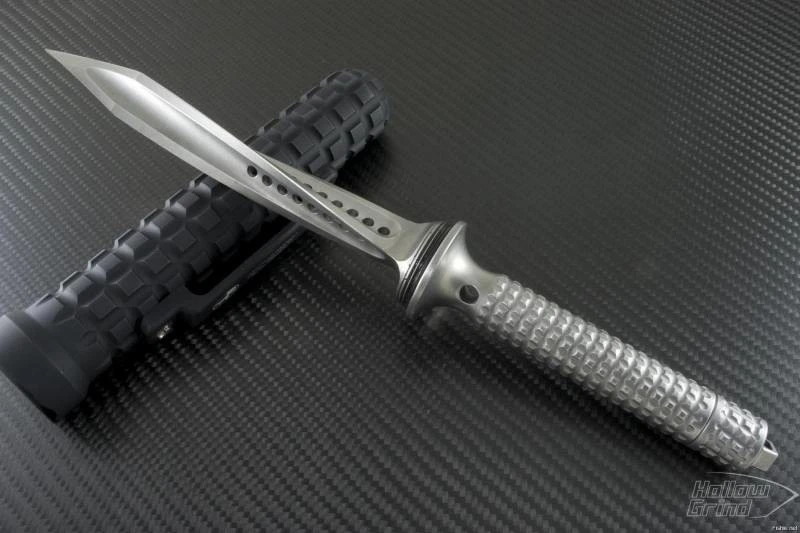
In reality, most crimes are committed with knives or other objects that do not fall into the list of bladed weapons. Most often they don’t even come close to it.
Actually, this was the case in the USSR.
Even a complete ban on carrying knives, as mentioned above, does not ensure that they or any other dangerous objects (screwdrivers, awls, hammers, etc.) are not used as bladed weapons when committing crimes.
Therefore, any prohibitive measures against chemical weapons are obviously ineffective. And they serve only as an imitation of vigorous activity on the part of legislators to obtain the approval of overly impressionable aunties and male persons equated to them.
Something like:
"Do not worry. Yes, you were stabbed. But it was done with an illegally carried knife. For this we will add two months to the criminal’s sentence.”
It is significant that the laws regarding knives are among the most liberal in the world.
In most countries of the world (both in the West and in the East), the laws in this regard are much stricter. However, as we said earlier, there is no benefit for citizens from this. This is just an illusion of security and order.
On the other hand, knives are not primarily self-defense weapons. A universal tool. One of the most popular in everyday human activity.
In addition to practical value, for many knives also have aesthetic value, serving as hobby items and/or collectibles.
Knives are produced by a huge number of companies.
It should be noted that recently very worthy examples of fixed and (more importantly) folding knives have been produced. (Making quality folding knives is much more difficult than making fixed ones.) 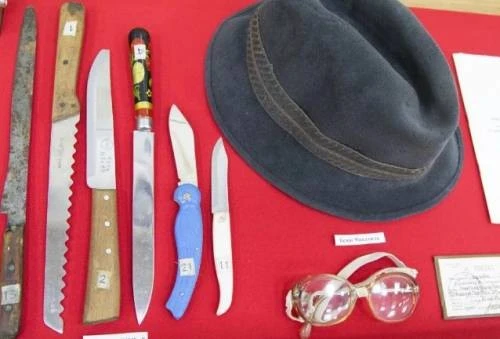
And here are Chikatilo's knives: